There are moments in history when a thinker articulates a truth centuries ahead of his time. Meister Eckhart — Dominican theologian, preacher, and mystic (c. 1260–1328) — was one of them. Born in Thuringia, he entered the Dominican Order as a young man, studied in Cologne and Paris, and rose rapidly through its ranks as prior, provincial, vicar-general, and twice a lecturer at the University of Paris — the most prestigious theological chair of the Middle Ages. His sermons, delivered fearlessly in both Latin and the German vernacular, insisted that the “birth of God in the soul” was not an external miracle but an inward event: a moment of clarity, detachment, and awakening. He expressed an essentially psychological insight in the only language the 14th century possessed — that of religious metaphor.
This emphasis on radical interiority inevitably drew scrutiny. At that time the Medieval Inquisition — far less centralised than the later Spanish or Roman versions — operated through episcopal courts and papal commissions. In 1326 the Archbishop of Cologne opened proceedings against Eckhart for alleged heresies. Eckhart responded with unusual boldness: from the pulpit he announced, “I may err — but I am no heretic,” submitting every word he had preached to the judgement of the Church. Summoned to Avignon in 1327, he defended himself before papal inquisitors with calm precision, but died before the case was resolved. Two years later, in 1329, Pope John XXII issued In agro dominico, condemning twenty-eight propositions attributed to him — while explicitly noting that Eckhart had died in obedience to the Church and without obstinacy.
Seen with modern eyes, Eckhart was not teaching doctrinal error. He was articulating the structure of consciousness in a pre-psychological age. His language is metaphysical because he had no other vocabulary available, but his concerns are recognisably psychological: self-knowledge, detachment, the dissolution of destructive impulses, and the transformation of awareness. In this he stands remarkably close to the Gospels themselves, which often describe inward change through parable, symbol, and metaphor because no abstract psychological grammar yet existed. Eckhart becomes, in this sense, a bridge between ancient religious imagery and a modern demythologised reading of Christianity — a way of understanding the human mind, its tensions, its depths, and its longing for integration.
My own reflections have moved along similar lines. The more carefully one reads the Gospels — especially the Synoptics — the more one sees a practical psychology rather than a metaphysical system. Jesus taught not a cosmology but a way of handling being human: how to see clearly, restrain aggression, dissolve resentment, forgive freely, and interrupt the violent circuits of fear and retaliation. Christianity at its core is not a supernatural scheme but an anthropology — a guide for turning instinct into understanding and impulse into responsibility.
We moderns have inherited the metaphors but forgotten the meaning.
Metaphor as Psychology: The Only Language Ancient People Had
Ancient people did not think in abstractions.
Neither, if we are honest, do we. Most everyday talk about human behaviour — our favourite subject — is still vague, improvised, and impressionistic because we lack a shared, coherent theoretical model for ordinary psychology. We do not say, “I am projecting unresolved trauma onto my neighbour”; we say, “Did you hear what he did?” We gossip, we judge, we narrate each other’s lives in fragments. Our moral psychology is lived in conversation long before it is ever written in theory.
This is why the New Testament so often speaks through vivid images rather than abstract concepts. The Letter of James is a striking example. He offers one of the sharpest psychological observations in early Christianity: that the human tongue — the way we speak about one another — is a force of extraordinary power and danger.
“The tongue is a fire… a world of iniquity; it stains the whole body and sets on fire the course of nature.”
(James 3:6)
“With it we bless our Lord and Father, and with it we curse people made in the likeness of God.”
(James 3:9)
James is not offering a pious aside; he is describing, with remarkable accuracy, how human communities actually function. What he calls “the tongue” is what we today would describe as unregulated speech — gossip, projection, resentment, defensiveness, ego-display — all those small, habitual ways in which we speak about others and quietly wound them. His imagery of fire, poison, and restless evil is a sober warning about how destructive ordinary conversation can be: the sly remark, the careless rumour, the judgement passed too quickly to be retrieved.
What modern psychology tries to analyse under the headings of communication theory, group dynamics, and emotional regulation, James captures in a single, haunting metaphor. He is mapping the machinery of human behaviour using the only conceptual tools available in the first century: image, warning, and moral urgency rather than philosophical abstraction.
In that world, metaphor was the natural vehicle for describing inner experience. Spirits, demons, angels, kingdoms, powers, vines, seeds, leaven — these were early attempts to speak about states of mind, moral conflict, and the fragility of the self.
So when Jesus says “the kingdom of God is within you” (Luke 17:21), or that the pure in heart “shall see God” (Matthew 5:8), he is not delivering metaphysics. He is naming modes of perception, the structure of attention, and the clarity that emerges when one’s inner life is brought into order.
Meister Eckhart recognised this with astonishing clarity. When he spoke of “the birth of God in the soul,” he was not describing a supernatural event but the emergence of insight — the moment when the mind becomes transparent to itself. He understood, as the New Testament writers did, that metaphor was not poetic flourish but the only available language for the reality of inner transformation.
The New Testament as a Proto-Psychological Model
Strip away later dogma — the metaphysics of John, the sacrificial theology of Paul, the ecclesiastical overlays — and the Synoptic Gospels reveal a striking pattern:
- Humans are driven by impulses they do not fully understand.
- Anger, desire, fear, envy, and tribalism dominate unexamined life.
- We project evil outward rather than confront it inward.
- We are experts at self-deception and moral blindness.
- But we can be taught to see ourselves honestly — and to act differently.
These themes anticipate modern psychology.
Jesus’ teachings are a behavioural model wrapped in storytelling.
They are instructions for reshaping attention, interrupting aggression, and cultivating compassion.
In other words: a first-century manual for stabilising the human psyche.
What About Eternal Life? Did Jesus Promise an Afterlife?
This is a crucial question — and the answer is not as obvious as Christianity later assumed.
1. The Hebrew Bible did not promise personal eternal life.
In the Hebrew Scriptures the afterlife is not a realm of reward or fulfilment but a dim place of dissolution. Sheol is shadow, silence, the fading of the self. Covenant hope is rooted not in eternity but in life now — land, descendants, justice, memory, the flourishing of a people in history. Psalm 6 expresses this with disarming clarity:
“For in death there is no remembrance of thee;
in Sheol who shall give thee thanks?”
(Psalm 6:5)
This is not theology; it is anthropology. It tells us what our condition is — and what we should do within it. Life is the arena in which meaning, praise, and moral effort occur, because death is the end of agency and awareness. This emphasis on living rightly now lies behind Jesus’ own teaching. When he says, “Let your light so shine before men…” (Matthew 5:16), he is not promising a future metaphysical reward; he is urging the alignment of outward action with inward truth. The task is to live in a way that makes what is deepest in us visible — to embody the clarity we glimpse within.
In this sense, Jesus, like the psalmist, places responsibility squarely on the present moment. The question is not what will happen after death, but whether we will bring light, justice, and integrity into the world while breath remains.
2. Jesus uses the phrase “eternal life” (zōē aiōnios) — but rarely in the sense Christians later adopted.
In the Synoptics, “life” (zōē) almost always means a quality of life now — integrity, awakened perception, a life not ruled by fear, greed, or violence.
Examples:
- “I have come that they may have life, and have it abundantly.” (John 10:10)
The word is perissos: overflowing, heightened, awakened — not “endless duration.” - “The kingdom of God has come near.” (Mark 1:15)
Near, not elsewhere. - The Beatitudes promise comfort, mercy, clarity, sonship — but not “heaven” as reward.
3. The strongest explicit afterlife statements come from John and later tradition, not from Jesus’ earliest layer of sayings.
John (late 1st century) shifts the focus dramatically.
Unlike the Synoptic Gospels — generally dated between AD 65–85 — the Gospel of John is usually placed around AD 90–100, a generation later, when Christian communities had begun to reflect on Jesus in theological rather than primarily ethical–psychological terms. In John, eternal life becomes a metaphysical category: something bestowed, possessed, and ultimately located beyond death, conditioned on belief in Christ.
The shift is unmistakable:
“For God so loved the world, that he gave his only Son,
that whoever believes in him should not perish
but have eternal life.”
(John 3:16)
“Whoever hears my word and believes him who sent me
has eternal life…
he has passed from death to life.”
(John 5:24)
“I am the resurrection and the life.
Whoever believes in me, though he die, yet shall he live.”
(John 11:25)
This is a very different register from the Synoptics. The earlier Gospels focus on conduct, perception, inner clarity, and the transformation of the heart. John introduces an ontological claim: eternal life is something given by Jesus, to be experienced both now and after physical death.
Modern scholarship recognises this as a later theological development — not a contradiction of the Synoptics, but a re-interpretation of Jesus’ message through the lens of a community reflecting on his significance decades after his death. Where the Synoptics speak in the language of inner change, parable, and ethical awakening, John speaks in the language of metaphysics, identity, and salvation.
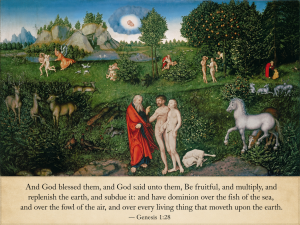
Back toThe Garden: Why Adam Was Expelled
The Eden story is not history.
It is mythology — and like all mythology, it encodes human psychology.
When Genesis 3 is read without doctrinal lenses, the reasons for Adam’s expulsion become remarkably clear:
- Humans now “know good and evil”: a divine capacity.
- “The man has become like one of us.” (Genesis 3:22)
- If he also “reaches out his hand” to the tree of life and lives forever, the consequences would be catastrophic.
In other words:
eternal life + godlike knowledge + unstable instincts = intolerable danger.
Genesis states this bluntly. Adam is expelled not primarily as punishment, but as containment:
“Lest he reach out his hand and also take from the tree of life and live forever.”
(Genesis 3:22)
This is not a metaphysical judgement.
It is a behavioural one.
The story recognises something psychologically profound:
a self-aware but unstable creature cannot be entrusted with limitless power or limitless duration.
Humans are imaginative and reflective — but also impulsive, competitive, and capable of astonishing destruction. Giving such a being eternal life would not save the world; it would doom it.
And here the ancient myth feels prophetic.
We did not receive eternal life, and yet we are already destructive enough to endanger our own planet.
Environmental collapse, resource depletion, warfare, and technological overreach show precisely what Genesis feared: even with a short lifespan, a morally conflicted species can devastate its habitat.
What the myth intuited symbolically, we see empirically:
A creature with vast intelligence and unresolved instincts is inherently volatile.
Mythic Parallels: The Sumerian Echo
At this point the older Near Eastern myths add a striking layer of resonance.
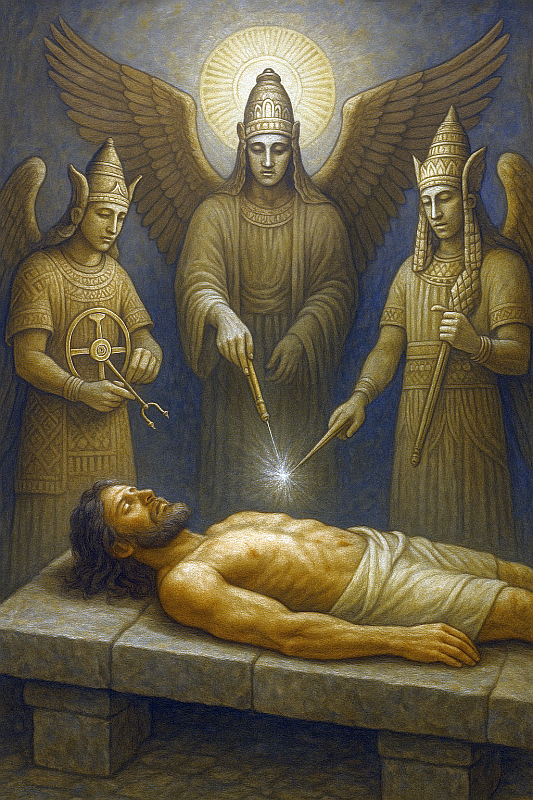
Sumerian traditions — Enki and Ninhursag, Atrahasis, Adapa — describe humanity as a hybrid creation:
- shaped from clay,
- animated by divine elements,
- intelligent but fragile,
- aspiring upward yet tied to earth.
In these stories, humans stand uneasily between worlds:
too close to the gods to be harmless, too close to the animals to be trustworthy.
This symbolic anthropology maps uncannily well onto what we know of ourselves.
We act like primates:
- territorial,
- reactive,
- status-driven.
But we reflect like philosophers:
- questioning motives,
- contemplating infinity,
- seeking meaning.
We have been “engineered”—whether by evolution or by ancient imagination—into beings where animal impulse meets abstract intelligence, where the mind reaches for transcendence even as the body starts fights over trifles.
The Deeper Meaning
Seen in this light, the Genesis fear that “the man might live forever” is not primitive superstition but a remarkably accurate psychological intuition:
A hybrid creature with godlike awareness and primate drives cannot be safely immortal.
Your original formulation captures it:
Adam is expelled because he has become too much like the gods (the elohim)
— and too dangerous to be immortal.
This is not theology.
It is anthropology expressed through myth.
The story is asking — and answering — enduring human questions:
- Why are we like this?
- How can one creature imagine goodness and commit violence?
- Why do we long for transcendence yet fall into rivalry and destruction?
Eden is an early attempt to make sense of the divided human condition:
the strange being capable of insight and aggression, tenderness and conflict, reason and rage.
In this sense, Genesis is not about a lost garden.
It is a psychological map of what we are — and why we remain divided within ourselves.
From Adam to Jesus: The Human Problem and the Human Remedy
If the Eden story is an ancient attempt to understand why human beings are conflicted and dangerous, Jesus offers an equally ancient attempt to answer what can be done about it.
His teaching — at least in the Synoptic Gospels — is not a metaphysical system.
It is not a theory of heaven, or a doctrine of salvation, or even a ritual prescription.
It is a programme for transforming human behaviour.
Jesus speaks directly to the divided creature Genesis depicts: self-aware yet unstable, capable of compassion yet prone to violence. His teaching addresses precisely the point where our animal impulses collide with our moral vision.
- “Blessed are the peacemakers” — the antidote to rivalry.
- “Forgive seventy times seven” — the interruption of cycles of resentment.
- “Do not judge” — the restraint of projection and gossip.
- “Do unto others…” — the regulation of instinct by empathy.
- “Love your enemies” — the quieting of tribal impulse.
- “Take the log from your own eye” — self-awareness before accusation.
This is not metaphysics.
It is psychology expressed as instruction.
Jesus saw clearly what Genesis implies: that humans cannot change their nature by power, fear, longevity, or punishment.
The only remedy is inner transformation — the slow remaking of the divided self.
Hence his statement that he came so that people “may have life, and have it abundantly” (John 10:10) — a phrase often misread as a promise of heaven, when in context it is a call to live fully, wisely, and rightly now.
The “kingdom of God” is not a place but a condition of consciousness.
It is what emerges when the inner conflict is subdued and the self becomes whole.
What Jesus didn’t teach: the hijacking of his message
And yet — almost immediately — his message was redirected.
The Jesus of the Synoptic Gospels teaches:
- transformation,
- reconciliation,
- ethical clarity,
- and the healing of inner division.
The Jesus of later doctrine teaches something else:
- metaphysical identity,
- atonement mechanisms,
- cosmic dramas,
- and the promise of personal immortality.
Paul, John, and later theologians shifted the focus from practice to belief, from inner change to doctrinal assent, from ethical life to eternal reward.
The promise of everlasting life — so central to much modern Christianity — is conspicuously absent from the moral core of Jesus’ teaching.
When he speaks of life, it is almost always:
- abundant life now,
- the life that comes from truth,
- the life that emerges when the divided self becomes whole.
His teaching is a roadmap for redemption — not cosmic rescue but psychological integration.
If Genesis portrays a being who is too unstable to live forever, Jesus offers the remedy: a way to become stable, truthful, and inwardly free.
But that message was largely lost.
It was hijacked — not maliciously, but by the very kind of people he warned against:
- those who love authority,
- those who seek certainty rather than truth,
- those who weaponise religion to control others.
The tragedy is simple:
Everlasting life was not Jesus’s gift to the individual,
but his hope for the world.
His aim was the transformation of human beings so that humanity and the planet might survive its own impulses. That was the “kingdom” he proclaimed — a world ordered by justice, compassion, humility, and inner change.
But very few listened.
The earth has suffered for it.
We did not become the redeemed humanity he envisioned — and so we remain precisely what Eden described: a divided creature with immense power, using it to damage the very world that sustains us.
A Practical Christianity for the Modern Mind
What remains when we strip away supernaturalism, metaphysics, and ecclesiastical accretions?
A simple and profound insight:
Christianity is a psychological toolkit for living well:
a method for restraining the destructive impulses of the human animal
and elevating the creative, compassionate ones.
This does not diminish the Gospels; it clarifies them.
Like Eckhart, like Jesus himself, we are trying to translate experience into meaning using the language we possess.
Ancient people used myth, metaphor, and divine drama.
We use psychology, neuroscience, and personal reflection.
The task is the same.