Human intelligence exists on a continuum. Some minds operate with astonishing speed and depth, others move more cautiously, and many are closed to intellectual speculation altogether. This variability is not a moral failure; it is the legacy of our primate origins. We are, after all, animals that learnt to think — creatures whose instincts evolved long before our rational capacities. The tension between those two systems shapes almost everything about the human condition.
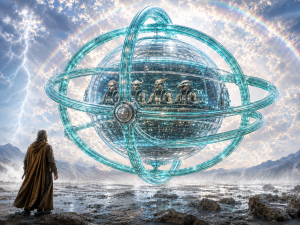
It is striking, then, to read the ancient texts that gave birth to our moral imagination. In Genesis, the Elohim respond with unease when humans acquire the knowledge of good and evil. “Behold, the man has become like one of us.” Behind this line lies a deep mythic anxiety: that human beings, equipped with consciousness, self-awareness, and moral agency, might rise beyond their allotted place.
To understand this fear, it helps to look at the world from which these myths emerged. The early Sumerian and Babylonian gods were not transcendent beings of compassion or enlightenment. They were, in nearly every respect, enlarged versions of ourselves — aggressive, quarrelsome, territorial, and unpredictable. The divine realm was a projection of the human animal mind, not an ideal of moral perfection. The gods of Mesopotamia fought, schemed, competed, and destroyed. They did not embody virtues; they embodied power.
The Code of Hammurabi reinforces this picture. Its world reflects little appreciation of human dignity or mercy. (Hammurabi himself was not a god but a mortal king who claimed divine authority from the sun-god Shamash; the harshness of the code reflects not his divinity, but the divine psychology of the gods he served.) Justice is retaliatory, stratified, and often brutal. Even the earliest layers of the Hebrew Bible show Yahweh in this mould: jealous, wrathful, protective of his tribe, and fierce in judgement. None of this is surprising. Ancient deities were mirrors held up to early human psychology — primate instinct magnified to cosmic proportions.
But humanity did not remain there.
Over centuries, something remarkable happened: a slow transformation of moral insight. The God of Israel changes across the biblical narrative, travelling from tribal war-god to ethical monotheism. By the time we reach the teaching of Jesus, we are confronted with an entirely different vision—not of domination, but of inner reconciliation.
Jesus’ message was not aimed at the intellectual elite, nor at mystics capable of abstract philosophical speculation. He spoke directly to ordinary people — fishermen, farmers, widows, labourers — and yet his teaching cuts deeper into the human psyche than the metaphysical systems of his age. What he attempted was extraordinary: to bring the divided self into harmony. Anger, lust, fear, resentment, envy, possessiveness — these primal impulses had to be reconciled with thought, intention, compassion, and love. The Sermon on the Mount is not a moral rulebook; it is a psychological manual for becoming whole.
In this light, Jesus stands not as a figure delivering doctrine from above, but as a teacher of integration. He understood what the ancient myths hint at: that our true danger is not the fear that we will become like the gods, but that we remain trapped below them — prisoners of instinct without the guidance of intellect, or prisoners of intellect without the warmth of instinct.
We do not admire Isaac Newton for his social graces or emotional stability. In fact, his life shows the opposite. Here was one of the greatest minds in history—a man who reshaped mathematics, physics, and cosmology—yet who struggled with ordinary human relationships. His brilliance in analysis was unmatched, but his inner life remained fragmentary. His immersion in biblical numerology, alchemy, and esoteric lore reveals a restless search for unity he never found. Newton mastered the universe but not himself.
I sometimes think back to a man I knew in my early twenties — Will Kite, a cigarette-smoking, beer-swilling barroom philosopher in the Smethwick pub I frequented. He was no scholar, yet he possessed a clarity that eludes many learnt men. Will often told me that death was the only certain thing in life, and he said it without fear or bitterness. He seemed content with who he was, untroubled by the need to be more than himself. In his rough, unpolished way, he displayed a kind of inner reconciliation that Newton never reached — a practical acceptance of life and mortality that aligned instinct and understanding with effortless naturalness. He had found, without theology or mysticism, the simple equilibrium that Jesus tried to awaken in all who heard him.
This contrast is telling. Intelligence alone does not produce wisdom; instinct alone does not produce love. The challenge of being human lies precisely in the reconciliation of the two. When intellect and instinct remain in tension, life fractures. When they are harmonised, something new emerges.
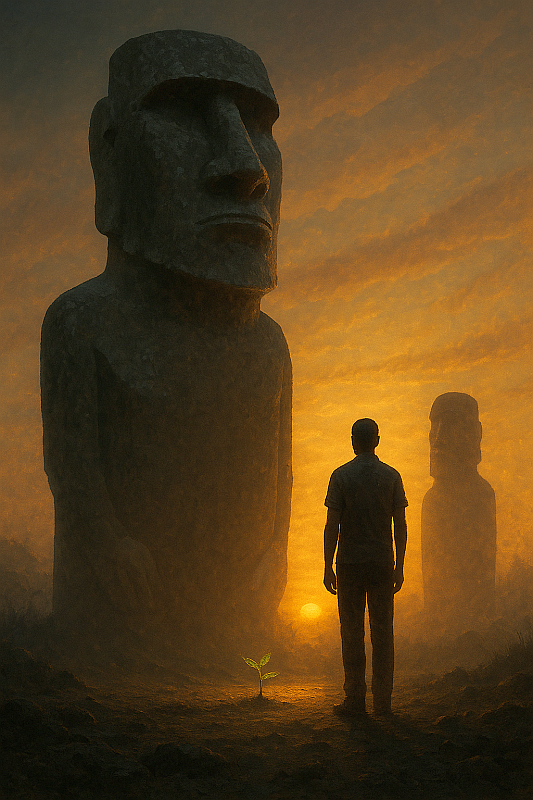
And perhaps this is the real point behind the ancient fear that humanity might “become like one of us.” Not that we would rival the gods in power, but that we might eventually surpass them in character. The old gods ruled through force, hierarchy, and conquest. But a human being who has reconciled instinct with intellect — who acts from love rather than fear, compassion rather than domination — becomes something the ancient world could not imagine.
Not a god of power, but a person of wholeness.
Yet one fact stands above all: we die. Jesus understood this with perfect clarity. Mortality is not a flaw in the human design; it is the key to our transformation. Only a dying creature feels urgency. Only a mortal being can forgive, relinquish, let go, and live from compassion rather than conquest. The gods of old, being immortal, could rage forever. Humans cannot. Death forces us toward completion. It demands reconciliation. It drives us toward love.
And this leads to the final truth — one that Jesus pressed upon his listeners with absolute insistence. If reconciliation is possible at all, it is only possible now. Not in some imagined future, and not in the afterlife, but in the immediate present where instinct and intellect meet, where fear and understanding touch each other, and where the divided self can finally come to rest.
If we are to be happy and reconciled, the only opportunity is now.
This moment is the doorway.
This moment is the task.
This moment is where the human being becomes whole.
Coda
And perhaps this is why Jesus spoke the words that have echoed through centuries: “Greater love hath no man than this, that he lay down his life for his friends.” It was not a statement of doctrine but of relationship. He did not call us servants or subjects. He called us friends. In offering his life, he showed what it means for instinct and intellect, fear and compassion, self and other, to be reconciled in one integrated human being. No greater love than this — and none more human.