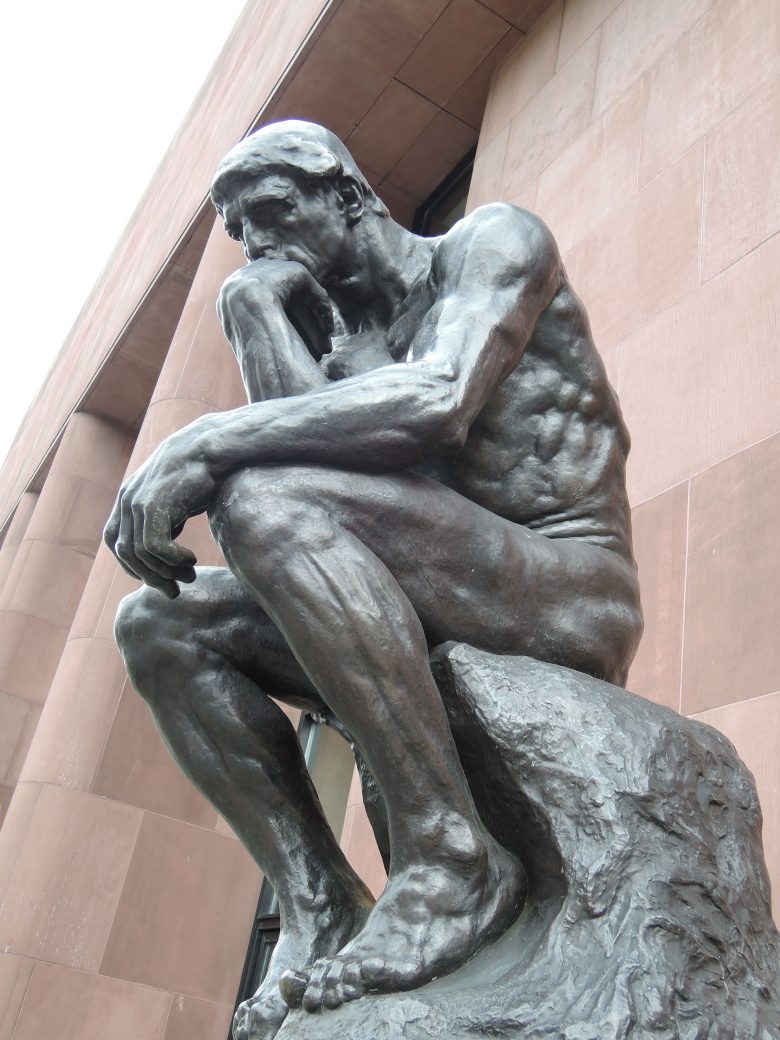
One of the most illuminating ways to understand religion is to see it as a symbolic language through which humanity reflects on its own existence. In this sense religion is neither simply a delusion nor a literal description of the structure of the universe. Rather, it is a form of collective self-interpretation, an attempt by human beings to express, through stories, symbols, and rituals, the meaning of their own experience.
This way of thinking about religion has deep roots in modern philosophy. The nineteenth-century thinker Ludwig Feuerbach argued in The Essence of Christianity (1841) that religion reflects human nature projected outward. His claim was both simple and radical: what believers attribute to God is in fact a reflection of humanity’s own highest aspirations. Divine love mirrors the human capacity for love; divine wisdom reflects the human longing for understanding; divine justice expresses the moral conscience that arises within human communities. In this sense, religion becomes humanity contemplating its own nature in symbolic form.
A similar insight appears in the work of the sociologist Émile Durkheim. In The Elementary Forms of Religious Life (1912), Durkheim concluded that when a society worships its god, it is in fact expressing reverence for its own collective life. Religious symbols embody the moral authority of the community and the shared values that bind people together. The sacred, therefore, represents the power of the group itself. Through religious language, societies articulate and reinforce the principles that make cooperative life possible.
Taken together, these ideas point toward a broader understanding of religion. Religion arises when rational animals begin to reflect on their own existence. It is neither merely projection nor simply social control, but a symbolic attempt to articulate the inner dimension of human consciousness and moral life. In that framework, the language of religion takes on a psychological depth. “God” may symbolise the deep moral centre of consciousness; “the Kingdom of God” may represent awakened moral awareness; and “salvation” may describe a process of inner reconciliation. Religious ideas thus become expressions of humanity’s attempt to understand the ethical and psychological dimensions of its own being.
This approach brings one close to a tradition that runs from Baruch Spinoza through Paul Tillich to Carl Jung, all of whom understood religious language as symbolic expressions of deeper realities within human experience rather than literal supernatural claims. Within such a framework, religious traditions retain their value not as cosmological explanations but as profound reflections on human consciousness and moral life.
Yet this symbolic understanding of religion has often been complicated by the claims of spiritual teachers who insist that advanced states of consciousness are literally real. Figures such as Osho suggested that human beings can attain higher forms of awareness—sometimes described as enlightenment, cosmic consciousness, or liberation. Similar ideas appear in many traditions, from Buddhist enlightenment and Hindu samadhi to Christian mystical union and Sufi ecstatic experience. These traditions often speak of transcending ordinary consciousness and entering a deeper level of reality.
Such claims raise a difficult question. Are these experiences evidence of access to a higher metaphysical realm, or are they intense forms of human psychological experience? Modern psychology and neuroscience tend to favour the latter explanation. Experiences described as mystical may arise from altered patterns of brain activity, meditation practices, powerful emotional states, or moments of profound aesthetic or existential insight. They can feel deeply meaningful and transformative without necessarily revealing a hidden structure of the universe.
The difficulty appears when such experiences are interpreted as evidence of spiritual hierarchy. Once the idea of higher spiritual states is accepted, some individuals inevitably claim to be more awakened than others. Gurus become authorities on reality, and followers defer to their supposed insight. History shows that such hierarchies can easily lead to the accumulation of power and the erosion of critical judgement. A more cautious interpretation recognises these experiences as part of the wide spectrum of human consciousness rather than as proof of privileged access to ultimate truth.
Underlying these reflections lies a deeper question about the human condition itself. Human beings are both animals and reflective minds. We share with other creatures biological drives, emotional instincts, and patterns of social behaviour. Yet we also possess capacities that create a new dimension of existence: self-awareness, abstract thought, moral reasoning, and the ability to choose against instinct. The philosopher Blaise Pascal expressed this paradox memorably when he wrote that man is “neither angel nor beast,” and that the misfortune lies in the tension between these two aspects of our nature.
Later thinkers such as Jean-Paul Sartre and Albert Camus interpreted this awareness as a burden. Human beings, they argued, are conscious of meaning and purpose, yet the universe itself appears indifferent. The result is the existential sense of absurdity that became characteristic of twentieth-century philosophy.
Yet the same condition can be interpreted in a far more hopeful way. The fact that humans possess reflective consciousness need not be seen as tragic. On the contrary, it may represent one of the most remarkable developments in the history of life. Animals largely follow instinct. Human beings possess the capacity for reflective choice. That capacity makes possible moral development, creativity, culture, and the deliberate shaping of our collective future.
In this sense consciousness is not a curse but an evolutionary gift. The philosopher Friedrich Nietzsche, despite his reputation for severity, understood something of this possibility. He rejected the pessimism that sees human awareness as a burden and instead emphasised the creative potential of human life. Consciousness becomes the basis for self-creation, for the affirmation and development of human existence.
Seen from this perspective, religion itself becomes part of humanity’s attempt to understand and cultivate this new dimension of life. Human beings are animals who have become aware of themselves. That awareness inevitably creates tension between instinct and reflection, but it also opens the possibility of moral insight, conscious responsibility, and spiritual depth. Rather than representing a tragic flaw, the emergence of consciousness marks the beginning of a new stage in the story of life, one in which humanity gradually learns to understand itself.
Perhaps this is why the teachings attributed to Jesus continue to resonate for many readers today. Their enduring appeal may lie not in the mythology that later surrounded them but in their emphasis on awakening, moral awareness, and inner transformation within the ordinary conditions of human life.