The Diamond and the Light: Why the Deepest Truth Cannot Be Taught
There are some truths that cannot be taught in the ordinary sense. They cannot be handed over like information, memorised like dates, or mastered like a school lesson. They can be pointed to, hinted at, lived before others, and perhaps recognised when the soul is ready — but they cannot simply be transferred from one mind to another. They must be experienced.
That, it seems to me, is why certain insights keep reappearing across history. Meister Eckhart, Tolstoy, and many others seem to have arrived at a similar point by very different roads. Their language differs, their background differs, and their theology differs, yet one senses that they are circling the same centre. Each had to discover it for himself. It could not be learned merely from books. Books may prepare the ground, but the thing itself comes only through some kind of inward contact with the divine — whether one understands that contact in physical, psychological, or metaphysical terms.
This raises an important question. Is the sense of the divine truly an encounter with an external transcendent reality, or is it anchored in the functioning of the brain? My own inclination is to think that the sense of the divine may indeed be rooted in the brain. That is, in one sense, a dark possibility. It seems to strip away the consoling idea that the experience comes from “outside” us. Yet it remains unverified. And even if it were true, the experience itself would remain what it is: real in effect, sustaining in force, and deeply upholding in human life.
That point matters. If the experience is brain-based, it is still experience. Love is mediated by the brain. Beauty is mediated by the brain. Music, grief, mathematical insight, moral conviction — all are inseparable from the living structure of consciousness. Their dependence on the brain does not make them false or trivial. In the same way, the sense of the divine may be neurologically grounded without being thereby worthless. Either way, the sensation is the same, and one which upholds.
Perhaps, then, it makes less difference than we suppose. If the divine is, it is. If it is not, it is not. In the meantime, life must still be lived. We still must endure, choose, suffer, hope, and act. We still must decide whether we are to live in anxiety, resentment, and fragmentation, or from some deeper place of trust, coherence, and inward alignment. One can spend a lifetime chasing metaphysical certainty and still not arrive. Meanwhile, the years go by. So perhaps the wiser course is simply this: continue to live, and attend carefully to what proves life-giving, truthful, and inwardly sound.
This is why Paul’s line remains so profound: “Then shall I know even as also I am known.” Whatever one may criticise in Paul, one can be grateful to him for that sentence.
In a few words, it expresses something that sages and wise teachers have returned to again and again: our present knowledge is partial. We see fragments, not the whole. Our understanding is clouded, indirect, and incomplete. Yet this broken knowledge is not meaningless. It is directed towards a fuller recognition of reality.
The deepest point is not simply that one day we shall know more. It is that our knowing is already held within a deeper knowing. We seek truth, but we are also already known by truth. That is the richness of the phrase. It suggests that the final reality is not isolation, not the solitary mind reaching out into darkness, but recognition: a meeting between what we dimly seek and what has already, in some mysterious sense, sought and known us.
What later mystics and sages seem to have grasped is that this cannot remain mere doctrine. It has to become inwardly real. One may read Eckhart and admire him. One may read Tolstoy and be stirred by him. One may quote Paul with reverence. But unless something answers within, the words remain words. Each had to discover the truth for himself, not because truth changes, but because it has to be awakened in consciousness. It is not learned like geography; it is realised.
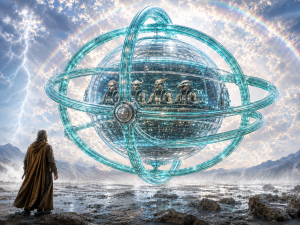
Yet the experiences of these men are not identical. Each person’s encounter is a little different. One might think of it as the faces of a diamond. Each facet catches the light at a slightly different angle. Each reflects something distinctive. Yet all belong to the same precious stone. Eckhart’s mystical language, Tolstoy’s moral awakening, Paul’s luminous intuition — these are not duplicates, but they may be facets of one truth. That is why they resonate across centuries. The same light is refracted through different minds, different cultures, and different temperaments.
This is also why enlightenment cannot truly be taught. At most, it can be pointed to. A teacher may suggest a path, expose an illusion, clear away confusion, or speak from the depth of lived experience. But the decisive thing cannot be passed on like a possession. It must become real in the life of the one who seeks it. That is why the greatest teachers often speak in hints, parables, paradoxes, and images. They are not delivering information so much as awakening recognition.
In that sense, demonstration is the purest form of teaching. Jesus understood this perfectly when he said: “Let your light so shine before men that they may see your good works and glorify your Father which is in heaven.” This is not an appeal to self-display, but to embodiment. Truth is not merely to be spoken; it is to be shown in a life. The deepest things are not proved by argument alone. They are made visible in conduct, in calmness, in charity, in courage, in patience, in integrity. One does not merely tell others about the light. One lets it shine.
That may be why the lives of genuinely wise people teach more than their books. The authority lies not first in what they say, but in what they are. Their words carry weight because they have been lived. That is true of the saints, the sages, the mystics, and indeed of any person who has touched something deeper than ego and has tried to live from it. Their example demonstrates what argument can only describe.
So perhaps the truth of these matters lies somewhere between metaphysics and experience. There may indeed be “something in man that answers to the divine.” Whether that answer is the result of a transcendent reality, the deepest structure of consciousness, or some mystery joining the two, I do not know. But I am increasingly persuaded that the practical question remains the same. What matters is whether one lives in contact with that depth or merely skims across the surface of life.
Books may point. Doctrine may frame. Theology may interpret. But in the end, the thing itself must be lived. Each soul must turn the diamond and catch the light for itself.