
Enoch Powell: Intelligence, Judgement, and the Problem of Immigration
Enoch Powell belonged to a type that has almost vanished from public life: the politician as scholar, linguist, classicist, historian, and serious opponent. He was not a routine party politician. He thought in long historical arcs and could express ideas with great compression and force. To argue with him publicly would have required more than quick answers or media training. One would have had to know exactly what one what talking about.
He was not a man to be dismissed with glib slogans. He had intellectual weight, historical memory, a command of language, and the habit of argument.
Powell’s academic record was unusually impressive, especially in classics. He entered Trinity College, Cambridge, as an Entrance Scholar in 1930, took a first in Classics in 1933, and was elected to a Prize Fellowship at Trinity in 1934. His scholarly work centred especially on the Greek historians Herodotus and Thucydides.
From 1934 to 1938 he remained at Trinity as a classical scholar. He then became Professor of Greek at the University of Sydney at the age of twenty-five, making him one of the youngest professors in the British Empire or Commonwealth. His Lexicon to Herodotus, published by Cambridge University Press in 1938, remains an important work of classical scholarship. It was followed by The History of Herodotus in 1939. He also revised Henry Stuart Jones’s edition of Thucydides’ Historiae for Oxford University Press.
His range was not confined to formal scholarship. He served as Curator of the Nicholson Museum at the University of Sydney and published poetry, beginning with First Poems in 1937. In short, Powell was not simply a clever politician. He had been a serious classical scholar, a Cambridge fellow, and a professor of Greek at twenty-five.
His family background was educational rather than privileged. His father, Albert Enoch Powell, was a schoolmaster, later described as a primary school headteacher. His mother, Ellen Mary Powell, née Breese, had also been a teacher. The family lived in the Birmingham area, and Powell’s upbringing was shaped by education, discipline and study. His mother is said to have given up teaching and learnt Greek in order to teach it to him.
There is no reason to think that Powell reached Cambridge through money or social influence. The evidence points to merit and scholarships. He won a scholarship to King Edward’s School, Birmingham, and entered Trinity as an Entrance Scholar. His later first in Classics and Prize Fellowship confirm the same pattern.
Powell’s later political reputation often obscures the kind of man he was. He was intellectually formidable. He could argue from history, law, language and constitutional principle. Whatever judgement one reaches about his politics, he was no shallow performer.
In a rarely seen segment from his 1971 interview (see above) with the American television interviewer, Dick Cavett, Powell explained the context behind his 1968 immigration speech, made in opposition to the proposed Race Relations Bill. His argument was that Britain’s immigration problem had arisen from its imperial history and from the lack of a clearly defined national citizenship.
Powell rejected the label “racist”, treating it as an undefined term of abuse rather than a precise political description. He also argued that “race” was, in important respects, an American category which did not map easily onto the British situation. In the United States, he said, race carried the particular historical burden of black slavery and its aftermath. Britain’s difficulty, as he saw it, had a different origin: not domestic slavery, but empire, decolonisation, and the movement of former colonial subjects into Britain itself.
His argument was constitutional and demographic. Britain had never defined itself in the same way as countries such as the United States, France or Germany. There was no narrow national citizenship. People were British subjects, if they owed allegiance to the Crown. As the Empire expanded, millions of people across the Empire became British subjects too.
This created a legal difficulty after the war. British law had not clearly distinguished between those who belonged to the United Kingdom and those who were British subjects from elsewhere in the Empire or Commonwealth. That arrangement could work while movement was limited. It became a political problem once large-scale movement became possible.
Powell pointed to the post-war change in transport, especially air travel. Movement between continents became easier and cheaper. Commonwealth citizens could come to Britain under a legal framework that had not been designed for mass settlement.
He argued that by the time Parliament acted in 1962, the issue had already become politically charged. Since 1948, significant numbers of Commonwealth migrants had settled in Britain under the rights created by the British Nationality Act. The 1962 Commonwealth Immigrants Act therefore came after the fact: it attempted to restrict further entry once immigration had already become a visible and contentious part of British public life.
In the Cavett interview, Powell defined the issue as demographic and cultural rather than racial in the crude sense. His concern was that, unless there was a drastic change, parts of British cities would be occupied by populations with little in common with the settled population.
He then explained the immediate context of the 1968 speech. It was made shortly before the Conservative opposition decided to oppose a Race Relations Bill. Powell said the party opposed the bill because it believed the bill would do more harm than good.
Powell spoke as a senior Conservative front-bencher, not simply as a private MP. He was then a member of Edward Heath’s Shadow Cabinet, and the Conservative front bench had decided to oppose the Race Relations Bill on the ground that it would do more harm than good. Powell was a natural, though controversial, spokesman for that position. He was an exceptionally forceful parliamentary speaker, represented Wolverhampton South West, where immigration was already a visible local issue, and had made immigration one of his central political concerns. I had some direct experience of that context: in 1968 I was employed in Wolverhampton to teach English as a Foreign Language, a post which reflected the new educational needs created by post-war immigration.
His argument was that the danger to race relations did not lie chiefly in discrimination against immigrants. It lay, he said, in the fear felt by the settled population as immigrant numbers increased. As MP for an affected area, he said he was trying to explain that fear to parts of the country that had no direct experience of it.
He also said that the strong public reaction to his speech came from people who felt that their lives and neighbourhoods had been changing while public figures avoided the subject. In his account, the speech produced relief because someone had finally spoken about what many people already regarded as a serious problem.
The core of that argument was not racial in its starting point. Britain had inherited an imperial nationality system. Commonwealth citizens had a legal route into Britain because they were British subjects or Citizens of the United Kingdom and Colonies. That arrangement had not been built for large-scale migration into the United Kingdom itself. By the early 1960s the law had begun to change, but the political issue had already emerged.
The controversy lies in the way Powell framed the consequences. He moved from a constitutional and demographic argument into predictions of social displacement and conflict. Many heard racial fear in those predictions, even though Powell insisted that his argument concerned national belonging, numbers and social cohesion.
There is a further qualification. Over time, integration often takes place through ordinary life rather than ideology: school, work, marriage, housing, friendship, popular culture and language. Language is one of the strongest signs. The first generation may retain the language of origin as the language of home and memory. The second generation is often bilingual, but English becomes dominant in education, work and social life. By the third generation, the ancestral language is often weakened or lost unless religion, family or community structures preserve it.
The 2021 Census supports the broad point that English remains overwhelmingly dominant in England and Wales. Most residents aged three and over reported English, or English/Welsh in Wales, as their main language. A further group reported proficiency in English even where it was not their main language. Only a small minority said they could not speak English well or at all.
Among migrants, the same pattern appears over time. ONS analysis found that those who had arrived earliest were much more likely to report English as their main language than recent arrivals. The Migration Observatory also notes that English proficiency is widely regarded as central to integration, and that most migrants report speaking English well or very well.
This means that the story is not only one of permanent separation. Migration can cause strain when numbers rise quickly and settlement is concentrated in particular places. Yet children and grandchildren usually come to belong linguistically and socially to the country in which they are educated. Families may preserve food, religion, names, kinship patterns or festivals, but the daily operating language tends to become English.
Powell’s case therefore raises two questions. The first is whether his basic diagnosis of Britain’s post-imperial citizenship problem was well founded. On that point, his argument has force. Britain had inherited an imperial system of nationality that was not designed for large-scale settlement in the United Kingdom itself.
The second question is whether his proposed remedies were irrational or racist. I do not think they were. Powell argued for strict control of further immigration, a clearer definition of national belonging, and voluntary assisted re-emigration for those who wished to leave. He did not argue that immigrants lawfully settled in Britain should be treated as second-class citizens.
That distinction matters. A state may owe full rights and fair treatment to those legally resident within it, while also deciding that future entry must be controlled. There is no contradiction in that position. It is a normal function of government.
Nor should an unpopular view automatically be labelled right-wing or racist. A view may be wrong, harsh, badly expressed, or politically unwelcome; but it still has to be answered by argument. To dismiss a constitutional and demographic argument as racist simply because it challenges the prevailing moral language is not analysis. It is evasion.
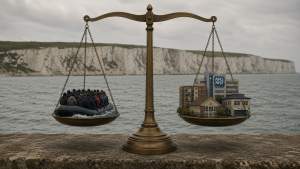
Powell’s argument was uncomfortable because it touched a real problem: how a small, densely populated country should manage numbers, belonging, settlement and social cohesion. That problem has not disappeared. Present governments still wrestle with entry controls, illegal immigration, asylum, removal, integration, housing pressure and public confidence.
There is also a longer view. Over generations, many immigrant families become integrated through school, work, language, friendship, marriage and ordinary daily life. English becomes the common language, and children and grandchildren usually come to belong socially and linguistically to the country in which they are educated. The first period of rapid change may cause strain, especially where numbers are large and change is concentrated in particular towns or districts. But strain at the beginning does not mean that permanent separation must follow.
I assume that successive governments have already tried to stem immigration as far as they practically can. This does not mean that immigration is under control, or that public alarm is without cause. It means that the state may have reached the limits of what can be done within existing law, international obligations, labour-market needs, administrative capacity and political reality.
After fifty years, Powell continues to challenge because he forces questions Britain still finds hard to answer. How should the country define belonging after empire? How many people can it absorb without social strain? How can it maintain equal rights for those lawfully here while controlling future entry? How can it speak honestly about public anxiety without turning lawful residents into scapegoats?
These were not, in themselves, racist questions. They were political and practical questions: how many people could be absorbed, at what pace, under what legal conditions, and with what consequences for housing, schools, employment, language, public order and social trust. What distinguished Powell was that he asked these questions directly, and in a form that many people found shocking. The phrase later attached to the speech, “rivers of blood”, was not Powell’s own phrase and was not a crude slogan. It came from his closing allusion to Virgil’s Aeneid, Book 6, where the Sibyl foresees “wars, dreadful wars” and “the Tiber foaming with much blood”: bella, horrida bella, / et Thybrim multo spumantem sanguine cerno. Powell’s own words were, “like the Roman, I seem to see ‘the River Tiber foaming with much blood.’” The allusion was dramatic and ominous, certainly, but it should not be treated as though it were simply an incitement. Powell showed political foresight in forcing these matters into the open, though the reaction to him also helped to make rational discussion more difficult. Many of the same questions are still evaded today, or answered only through denunciation rather than careful thought.
Powell’s language was in some respects too learned for the political culture into which it was released. His classical allusions, biblical cadences and formal style belonged to an older rhetorical tradition. Many who heard the speech did not recognise the allusions or follow the distinction he was trying to make between race, nationality, law and social order. They heard instead a threat or prophecy of racial violence. Powell’s closing image was poetic exaggeration meant as a warning, not an incitement to violence. The later title “Rivers of Blood” simplified and hardened the phrase, making it sound cruder than Powell’s actual words: “the River Tiber foaming with much blood.” The allusion was dramatic and ominous, but it belonged to the language of classical prophecy rather than to the language of street agitation. That misunderstanding, whether innocent or deliberate, helped to fix the speech in public memory under the misleading title “Rivers of Blood”.