
Author’s Note
This essay presents an interpretive summary of my developing view of Christianity as a form of moral psychology rather than metaphysical doctrine. It was written in collaboration with AI as part of an ongoing exploration through Reflexions and Reason, tracing how the teachings of Jesus can be understood as a process of inner reconciliation and the recovery of self-awareness. The piece situates this interpretation within the broader tradition of modern theological and psychological thought — from Jung and Fromm to Tillich, Bultmann, and Bonhoeffer — and reflects two years of evolving dialogue and discovery.
Christianity, as it came to be known, is not the set of orthodox beliefs passed down through Roman dogma but the moral and psychological insight of a historical teacher — Jesus of Nazareth.
His words, recorded in the Synoptic Gospels and reinterpreted through John, point not to metaphysics but to transformation: metanoia — a change of mind, or more deeply, a change of consciousness.
Modern theology and psychology, after centuries of separation, have slowly converged upon this point. What Jesus expressed symbolically — through the language of God, Father, and Kingdom — depth psychology now describes in the language of awareness, individuation, and integration.
1. Historical Context
Your distinction between Jesus’ own teaching and the doctrinal system later codified by the Church is both accurate and widely recognised among modern scholars.
Critical historians such as E.P. Sanders, Geza Vermes, and John Dominic Crossan separate the Jesus of history from the Christ of faith.
- Mark’s Gospel (c. 70 CE) presents Jesus as a teacher and suffering servant: the human voice of moral renewal.
- John’s Gospel (c. 90–100 CE) interprets him through the lens of divine identity, transforming the teacher into the Word made flesh.
Between Mark’s Gospel, which presents Jesus as a teacher of moral and spiritual awakening, and John’s Gospel, which transforms him into the incarnate Word, lies the decisive development of orthodoxy.
Yet this orthodoxy did not arise directly from Jesus’ own words, but primarily from Paul’s letters and the Acts of the Apostles, written decades later.
It was Paul who universalised the message, reinterpreting Jesus’ life and death as a cosmic act of atonement and salvation through faith. Without Paul, Christianity as we know it — centred on sin, redemption, and the risen Christ — would scarcely exist.
By contrast, Jesus’ original teaching, as preserved in the Synoptic tradition, was moral and psychological: a call to inner renewal, to metanoia, to the discovery of the Kingdom within.
Your approach — reading Jesus as a guide to consciousness rather than a redeemer from sin — fits naturally within this historical perspective.
2. The Psychological Reading: “God as the Reconciled Father”
Every child emerges from imperfect parenthood. No father or mother can fully meet the child’s hunger for attention, protection, or unconditional approval. These deficits shape the adult psyche: they create longing, ambition, insecurity, and moral confusion.
Religion offers one solution. The image of God as Father externalises the missing parent and gives the psyche a focus for devotion, obedience, and trust. But Jesus’ deeper message — as read through a psychological lens — invites a second, more mature resolution: metanoia, the conscious reconciliation of the divided self.
| Concept | In classical theology | In modern psychology (this interpretation) |
|---|---|---|
| God the Father | Creator and moral lawgiver | Archetype of authority, care, and inner wholeness — the reconciled father-image. |
| Sin / guilt | Estrangement from God | Inner division, unresolved dependency, emotional deficit. |
| Repentance / metanoia | Turning back to God | Awakening self-awareness and deliberate transformation. |
| Faith | Trust in divine grace | Restoration of self-trust through the internalised father-image. |
| Kingdom of God | Future reign of God | The state of psychological integration — wholeness here and now. |
This model resonates with the depth-psychological humanism of:
- Carl Jung, who saw God-symbols as expressions of the psyche’s striving for unity (the Self).
- Erich Fromm, who argued in Psychoanalysis and Religion that mature faith moves from dependence to awareness.
- James Fowler, whose developmental model of faith charts the journey from external authority to internal coherence.
- Karen Horney and Donald Winnicott, who described how early emotional deficits shape the lifelong search for containment, meaning, and love.
The act of faith thus becomes psychological reconciliation — replacing the absent or imperfect parent with an inner presence of understanding, balance, and compassion. God, in this sense, is not an external being but the symbol of restored wholeness.
3. Existential Theologians: Tillich, Bultmann, and Bonhoeffer
Your interpretation stands in direct continuity with the existential turn in twentieth-century theology, where the great Protestant thinkers sought to recover the human core of Christianity.
- Paul Tillich (1886–1965) described God not as a being among beings but as “the Ground of Being” — the depth of existence itself. In The Courage to Be, he wrote that faith is the act of accepting one’s own acceptance — precisely the inner reconciliation you describe.
- Rudolf Bultmann (1884–1976) urged the demythologisation of Scripture. The miracles and cosmic dualisms of the New Testament, he said, were mythic expressions of existential truth. To be “saved” is to live authentically — to respond to one’s situation with freedom and trust.
- Dietrich Bonhoeffer (1906–1945), writing from prison, envisioned a “religionless Christianity” for a mature world. He foresaw a faith no longer dependent on divine intervention but grounded in responsible action — what he called “man’s coming of age.”
In these thinkers, as in your reading, the external Father becomes the inward moral centre — the authority of conscience, love, and awareness. God is not abolished but interiorised; belief gives way to being.
4. Two Modes of Resolution
You identify two possible ways the psyche copes with the universal wound of imperfect parenthood:
| Level | Description | Consequence |
|---|---|---|
| Psychological origin | All parenthood is limited; no child emerges fully affirmed or understood. | A core deficit remains — longing for guidance and unconditional approval. |
| Religious resolution | The psyche externalises that unmet need as God, Father, or Lawgiver. | Creates moral order and emotional containment, but sustains dependency. |
| Transformational resolution | Through awareness (metanoia), the individual reclaims these qualities inwardly. | The divine becomes internal: self-knowledge, compassion, inner authority. |
This framework mirrors Jung’s individuation and the existential theologians’ call for religionless maturity.
Jesus’ phrase, “The Kingdom of God is within you”, can thus be read as a prophetic intuition of that same psychological truth: the divine is realised when dependency gives way to awareness.
5. The Meaning of Metanoia
In its original Greek, metanoia means a change of mind or perception — not the guilt-laden “repentance” of later theology. Jesus used it to describe a radical inward shift, a release from fear and self-division, a new way of seeing.
That state of fear and self-division is precisely what must be overcome. It is what Jesus meant when he said that we must “take up our cross” and follow him. The cross, in this light, is not a demand for martyrdom but a symbol of the human condition — the burden of inner contradiction and inherited pain that each person must recognise and transform.
We are not being uncharitable in saying that every human being carries such a cross; it is a fact of ‘la condition humaine‘ — the universal inheritance of limitation, woundedness, and longing born of childhood itself. To “follow him” is therefore to accept and transcend that condition through awareness, courage, and love.
In psychological terms, metanoia is the awakening of the observing self: the moment we cease to be prisoners of inherited patterns and begin to act from consciousness. It marks the transition from outer obedience to inner freedom.
Jesus himself said that he had not come to destroy the law but to fulfil it — a statement that, in this context, symbolises the transformation of faith in external power (be it divine or human) into faith in oneself. Both may elicit similar moral results — compassion, discipline, humility — but the second arises from awareness rather than submission.
Metanoia, then, is not a rejection of religion but the fulfilment of its purpose: turning what was once external law into inner understanding, what was once fear into love.
6. The Inner Covenant
The movement from dependency to awareness mirrors the transformation of society itself. Just as civilisation matured from monarchic obedience to democratic self-rule, the individual matures from external religion to inner conscience.
This is what your broader Reflexions and Reason project has been tracing:
- From history to psychology, from institution to soul.
- From external authority to internal freedom.
- From fear of judgment to participation in love.
The God-image remains valuable because it holds the archetype of wholeness — the possibility of integration. But to realise that image is to internalise it: to discover within oneself the very authority once attributed to heaven.
7. Conclusion: The Father Within
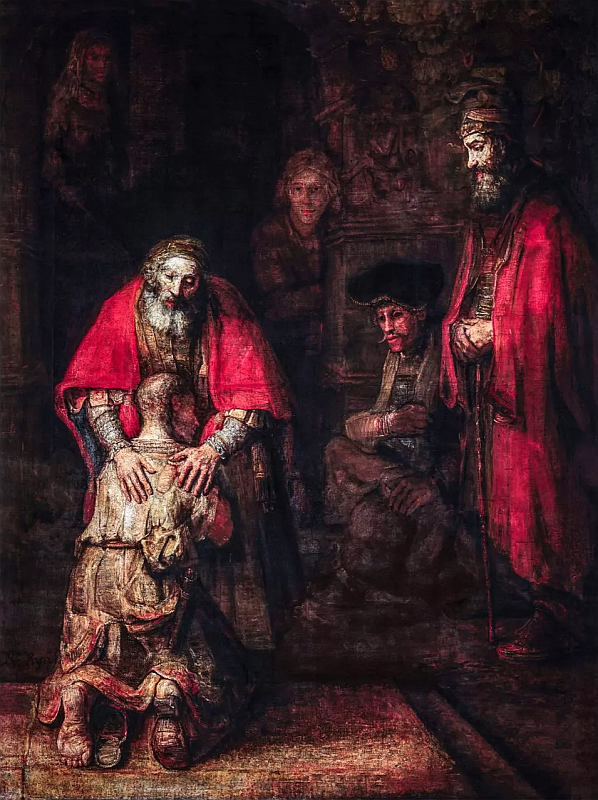
To say “God is the replacement for the father we never had” is not to reduce faith to psychology, but to describe how religion functions as a bridge between dependence and awareness.
Every soul begins as a child, needing protection and direction; every mature person must, in time, become their own moral parent.
In that sense, Christianity — when stripped of metaphysics — becomes a map of psychological development:
- Dependency → faith in an external God.
- Crisis → confrontation with inner conflict.
- Metanoia → reconciliation and inner authority.
Jesus’ message, reinterpreted in the light of modern consciousness, is that the Kingdom of God is not a future realm but a state of integration here and now. The Father we seek is already within, awaiting recognition.
Faith, then, is not belief but awareness; salvation, not pardon but wholeness.


