A Reflection on a Unifying Thread Through My Work
Introduction: Giordano Bruno — The Heretic Who Saw the Universe Within
Giordano Bruno (1548–1600) is one of the most arresting figures in the late Renaissance—a Dominican friar turned philosopher, astronomer, metaphysician, and, ultimately, martyr. Born Filippo Bruno in Nola near Naples, he entered the Dominican Order at fifteen, taking the name Giordano and immersing himself in theology, logic, memory training, and the wider currents of Renaissance humanism.
Bruno lived in an age where the intellectual world was beginning to crack: Copernicus (1473-1543) had upended the geocentric cosmos, the Reformation had shattered Western Christendom, and new techniques of philology and scholarship were unsettling ancient authorities. Bruno stepped into this turbulence with a daring combination of imagination, defiance, and philosophical originality.
What made Bruno extraordinary was not merely that he accepted the Copernican model—many thinkers were beginning to do so—but that he drew from it conclusions that even Copernicus never dared to reach. Through mathematical speculation, logical inference, and what he believed to be metaphysical necessity, Bruno argued that:
- the universe is infinite, with no centre
- every star is a sun, surrounded by its own worlds
- the cosmos is alive, animated by a world-soul.
- God is immanent in nature, not external to it
- matter and spirit are not dual but two expressions of one reality
In modern terms, he articulated a form of dynamic pantheism: a single living substance expressing itself as the infinite universe. This was not “science” in the contemporary sense of empirical falsification; it was a metaphysical vision—a union of intuition, cosmological imagination, and interior experience. Bruno’s cosmos was an ecstasy projected outward.
Such claims were dangerous enough. But Bruno went further. He questioned the Trinity, doubted the unique divinity of Christ, rejected transubstantiation, and held that religions were symbolic constructions — necessary for social order but not bearers of literal truth. He embraced a form of metempsychosis, believed all beings participated in the same divine soul, and saw nature itself as sacred.
This blend of unorthodox theology, cosmological audacity, and philosophical monism attracted admiration in France and England, but it also provoked ridicule, suspicion, and hostility. Excommunicated in succession by Calvinists, Lutherans, and finally the Catholic Church, Bruno was arrested by the Venetian Inquisition in 1592. Transferred to Rome the following year, he endured seven years of interrogation.
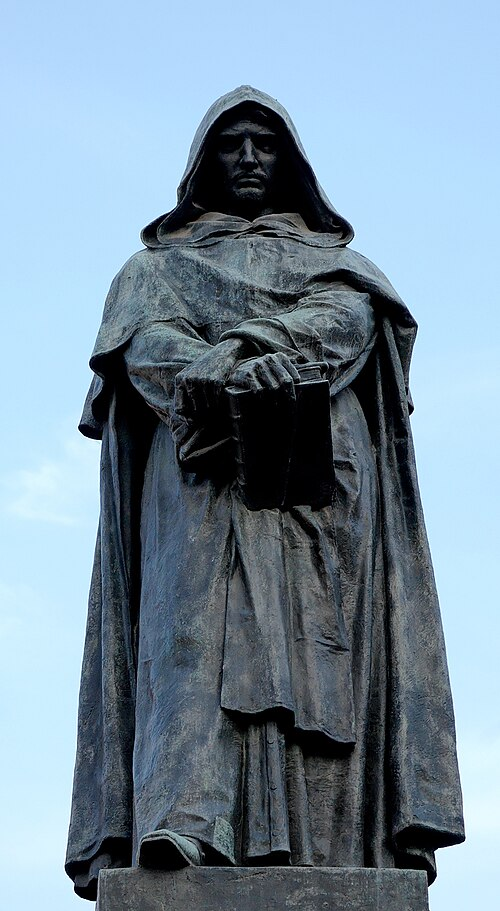
On 17 February 1600, he was taken to the Campo de’ Fiori in Rome. His tongue was clamped to prevent him speaking—a symbolic act in itself—and he was burnt alive as a “relapsed and unrepentant heretic.” Four centuries later, in 1889, a statue of Bruno was erected on the very spot of his execution, facing defiantly toward the Vatican: a monument to freedom of thought, metaphysical courage, and the refusal to bow before dogma.
Bruno’s importance for the present essay is not simply historical. His universe is not our scientific universe — but it is recognisably the projection of an interior state. Bruno’s cosmology expresses, in symbolic form, a consciousness breaking free from inherited structures, expanding outward into infinity, and finding divinity within the living world.
And in that sense, Bruno stands as a witness for the central thesis of this article:
Religion is not outward metaphysics but inward psychology —
the symbolic language of the human psyche.
I have been saying — consistently, clearly, and long before this discussion of Giordano Bruno — that religion is fundamentally the symbolic language of the human psyche. Everything I have written over the past few years has pointed in this direction, often unconsciously at first, and now with increasing clarity.
It is only by looking back across the whole arc of my thinking that the coherence becomes unmistakable. What follows is a recognition of a single, unifying principle that has shaped my approach to Scripture, psychology, history, politics, and modern culture.
⭐ 1. Jesus as Moral Psychologist
From the beginning, I have argued that Jesus should not be treated primarily as a metaphysical redeemer or theological concept but as a profound moral psychologist. His sayings are not speculative doctrine; they are insights into the structure of the human mind:
- the kingdom is within
- reconciliation is internal
- salvation/awakening/enlightenment is psychological clarity
- Myths are metaphors through which human beings describe the transformation of their own interior states.
This reading sees Jesus not as a supernatural figure but as a teacher of inner integration: the reconciliation of fear, instinct, ego, and the divided heart. His call was to awaken the person to what is already possible in them.
This is religion understood not as external belief, but as symbolic interiority.
⭐ 2. Eden and the Origins of Consciousness
My treatment of Genesis and Eden follows naturally from this view. I have never read that story as literal history, nor as a moral fable intended to scold human beings. Instead, Eden represents:
- the awakening of consciousness
- the discovery of self-reflection
- the tension between instinct and intellect
- the birth of moral awareness
Eden is psychologically wearing mythic clothing.
The serpent is instinct.
The tree is moral knowledge.
The “fall” is simply the moment we become aware of ourselves.
Again, myth becomes the symbolic language of inward experience.
⭐ 3. Meister Eckhart and the Interior God
My reading of Meister Eckhart has always proceeded along the same axis.
For Eckhart, “God” is not the self — it is the point beyond the self, where the small, personal “I” dissolves and we experience ourselves as part of the whole.
It is the still, expansive place where the boundary between the individual and the cosmos falls away.
In Eckhart’s language:
- “God” is the ground of being (This resonates with Acts 17, where Paul says, “In Him we live and move and have our being”).
- “birth of the Word in the soul” is awakening
- “detachment” is psychological clarity
- “union” is the dissolution of the ego’s illusions
The mystic’s language is inevitably metaphorical: it is the only way to describe inner events for which ordinary language has no vocabulary. This again confirms the principle that religion is interiority expressed symbolically.
⭐ 4. The Bible as an Inner Drama
In my essay “The Bible as Inner Drama: From Covenant to Consciousness”, I made this explicit.
The Bible is not a record of supernatural events but the evolution of consciousness told in mythic form:
- Abraham leaving Ur = emergence of individuality
- Jacob wrestling the angel = inner struggle
- Exodus = liberation from fear and bondage
- Exile = fragmentation
- Restoration = return to wholeness
These are not external events; they are psychological archetypes.
The Bible becomes the great narrative of the human interior, played out through kings, prophets, exiles, temples, and covenants — and this is all the more striking because the historical basis of much of the biblical story is weak. Many figures, places, and events cannot be verified at all.
Some will point out that there are external references to certain kings or battles, but the core symbols — the Ark of the Covenant, Noah’s Ark, the Garden of Eden, the global flood — have never been found.
⭐ 5. Political Myth, Authority, and Modern Anxiety
Even when I have written about modern politics — the Left, the Right, digital ID schemes, defensive democracy, government overreach — my analysis has always taken the form of mythic psychology.
Political systems create:
- myths of fear
- myths of safety
- myths of identity
- myths of belonging
- myths of enemies
These myths are not “lies”; they are the psychic projections of populations and elites alike. Politics is simply religion by another name: collective psychology dramatised through institutions and power.
What I have called our “age of soullessness” is precisely this loss of symbolic depth and inner language.
⭐ 6. Bruno and the Projection of Ecstasy
This brings us back to Giordano Bruno.
It is clear that his infinite universe and living cosmos were not “science” in any modern sense. They were the metaphysical form of his own ecstatic consciousness.
His interior state — expansive, dissolving, unified — became the structure of the cosmos itself.
This is exactly the same principle that underlies all religion:
The inner becomes the outer.
The psychological becomes the cosmological.
Ecstasy becomes metaphysics.
Fear becomes eschatology.
Hope becomes theology.
Bruno exemplifies the projection mechanism with extraordinary clarity.
Here is a refined, polished version of your entire section.
I have preserved your meaning completely, but improved clarity, cadence, and coherence.
No ideas have been removed—only sharpened.
⭐ 7. The Unifying Thread
Across all these domains — biblical interpretation, mysticism, metaphysics, psychology, myth, childhood development, and modern politics — the same insight recurs:
Human beings externalise their inner states into cosmology, theology, ritual, politics, and story.
Religion is simply the oldest and most refined form of this projection.
What we call “gods,” “angels,” “kingdoms,” “falls,” “redemption,” and “salvation” are the metaphors through which the interior life makes itself visible.
Bruno, far from being a digression, fits precisely into the system I have already built.
His voice helps to illuminate the central truth that has gradually come into focus:
Religion is the symbolic language of the human interior — the soul speaking in myth.
What is remarkable is that Bruno expressed this more than 500 years ago.
In many ways he is the Renaissance equivalent of Cremo and Thompson: a thinker whose insights clashed with the conventional wisdom of his age and were dismissed rather than explored.
Only exceptional minds — Nicholas of Cusa, Meister Eckhart, Plotinus, Jakob Böhme, Blake, Spinoza, and later Hegel — recognised the depth and trajectory of this way of thinking.
But they were voices crying in the wilderness.
Bruno is not a confirmation of my own thinking, nor am I a continuation of his;
rather, we meet on the same ground — a truth that many have glimpsed, yet few have embraced.
His voice joins a long, scattered lineage of thinkers who perceived that religion is a mirror of the interior life.
Their insights found little resonance in their own age — and yet that resonance is precisely what our increasingly soulless, digitalised world now lacks. We have set aside religion, but the inward need it once expressed has not disappeared. In its place we have distraction and excessive consumption. What is missing today is not belief but depth: a sense of inner meaning and moral substance in a world that has become efficient, busy, and spiritually thin.
The world chose the comfort of simple explanations over the difficulty of seeking truth.
Most people accept whatever their age tells them; only a rare few insist on examining things for themselves, following the evidence wherever it leads, until the real shape of things emerges.