Introduction: From Fear to Awareness
The story of religion, at least in the Judeo-Christian world, can be read as a gradual movement from fear toward understanding. Across the centuries, humanity’s image of God has evolved — not because God has changed, but because human consciousness has. From the stern commandments of early Judaism, through Isaiah’s tender compassion, to Jesus’ declaration that “the kingdom of God is within you,” we trace an extraordinary inward turn: divinity migrating from the heavens into the human heart.
The same movement reached its boldest form in the Gnostic writings of the early centuries, which taught that enlightenment meant remembering one’s divine origin. If we follow this line of thought to its conclusion, it seems to suggest that what humanity has long worshipped as external is, in some mysterious sense, already within us. Yet this idea, though inspiring, raises as many questions as it answers.
Isaiah’s Turning Point
The Book of Isaiah offers one of the most dramatic tonal shifts in the Bible.
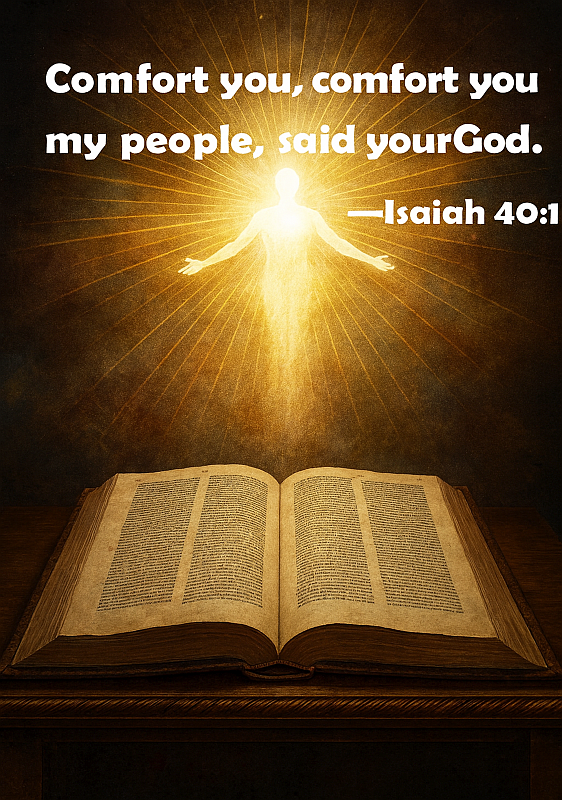
The early chapters depict Yahweh as jealous and punitive, demanding repentance through fear. But with Isaiah 40, a gentler voice appears:
“Comfort ye, comfort ye my people, saith your God.” — Isaiah 40:1
Here, divine wrath yields to tenderness. Scholars often note that this change marks the transition from First Isaiah to the so-called Second Isaiah — a text likely written later, in exile, when Israel’s suffering had deepened its moral insight. Whatever its origin, the effect is unmistakable: the human image of God becomes less authoritarian and more compassionate. It is as if divine morality were evolving alongside human consciousness itself.
Jesus and the Kingdom Within
When Jesus taught that “the kingdom of God is within you,” he carried this evolution to its natural climax. The divine ceased to be a distant monarch and became a living presence in the soul.
“You are the light of the world.” — Matthew 5:14
“The works that I do shall you do also.” — John 14:12
These sayings invert the usual relationship between master and disciple. The divine is not monopolised by the teacher; it is awakened in the listener.
This inner-kingdom theology suggests that salvation is not granted from without but recognised from within — an act of self-knowledge more than obedience.
Gnosticism and the Divine Spark
Gnosticism, though condemned as heresy, extends the same intuition to a cosmic scale. The material world, said the Gnostics, was fashioned by the Demiurge — a lower being ignorant of the higher light. Within each person burns a spark from the Pleroma, the realm of divine fullness. The task of life is not to worship the creator of matter but to awaken to the divine essence already hidden in us.
In symbolic language, this is not so different from Isaiah’s compassion or Jesus’ kingdom within. All three envision divinity as a potential in human consciousness — obscured by fear, law, and ignorance, yet always present.
The Human Mirror
Taken together, these developments imply that every portrayal of God may be, at some level, a mirror of human self-understanding. The jealous God of the desert reflected the anxieties of a tribal people. The merciful God of the prophets mirrored moral growth. The indwelling God of Christ revealed psychological maturity and spiritual insight. Each image, in its time, was true enough — and yet incomplete.
The Bible, seen this way, is not a static revelation but a chronicle of awakening. Its pages record humanity’s progressive discovery of what it means to be moral, compassionate, and self-aware.
Balancing the Vision
Such a reading is bold and, inevitably, controversial. It risks collapsing transcendence into psychology — turning God into a projection of our inner life. To say “man is God” can sound more like hubris than holiness. Classical theology insists that the divine is not simply the best part of us, but something wholly other, the ground of our being rather than our reflection.
Yet perhaps both truths can coexist. The transcendent God may be beyond us, but only by entering into us can that transcendence become meaningful. The divine remains larger than human consciousness, yet consciousness is the means through which it recognises itself. The mystics of every faith have wrestled with this paradox — that what is infinite and beyond form also speaks in the silence within.
The Path to Manifestation
If Isaiah, Jesus, and the Gnostics share a common thread, it is the movement from external authority to inward realisation. The purpose of faith, seen through this lens, is not submission but transformation. Prayer becomes remembrance; worship becomes awareness; morality becomes the expression of divine love through human life.
The challenge is to hold both humility and insight together — to awaken to the divinity within without losing reverence for the mystery beyond. The danger of self-deification is pride; its redemption is compassion. To manifest the divine is not to claim superiority but to live as a vessel of consciousness, mercy, and truth.
Conclusion: Becoming What We Seek
Read in its fullest sense, the Bible is a spiritual autobiography of humanity — from fear and obedience to self-knowledge and love. Isaiah’s comfort, Jesus’ inner kingdom, and the Gnostic spark are not contradictions but successive stages in the same awakening.
What once seemed distant and commanding is now intimate and participatory. God ceases to be a ruler over us and becomes the life within us. Yet even this discovery does not abolish mystery; it deepens it. For if divinity dwells in man, the task of man is to live divinely — not to replace God, but to reveal Him.