
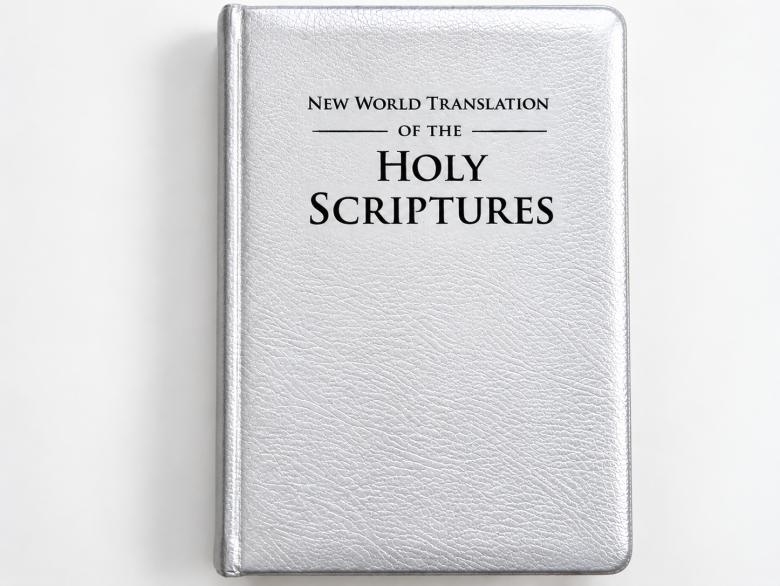
The New World Translation of the Holy Scriptures occupies a special place in the history of Jehovah’s Witnesses. The first part, the New World Translation of the Christian Greek Scriptures, appeared in 1950; the complete Bible followed in 1961. Its publication was received enthusiastically within the organisation. Watch Tower accounts describe convention audiences greeting the new translation with considerable excitement, and it rapidly became the Bible most closely identified with Jehovah’s Witnesses.
The familiar silver-covered edition, however, belongs to a much later period. The substantially revised edition issued in 2013 became widely known among Witnesses as the “Silver Sword.” The original complete 1961 edition was not the silver-covered Bible now familiar to many members.
Some criticisms of the NWT have concentrated on the qualifications of its translators. The Watch Tower Society has consistently described the work as that of an anonymous New World Bible Translation Committee, not a single translator. Because its members initially remained anonymous, their precise contribution is difficult to establish independently. Former members of the organisation later identified several individuals associated with the committee and claimed that Frederick W. Franz possessed the strongest knowledge of biblical languages among them. It would therefore be unsafe to say that the Bible was translated by one man, or that the translator had only a rudimentary knowledge of Hebrew. What can be said is that the translation was produced by an anonymous committee whose formal academic qualifications in Hebrew and Greek were not comparable with those normally associated with major scholarly Bible translation projects. The NWT itself states that its Hebrew Scriptures were principally based on Rudolf Kittel’s Biblia Hebraica.
One of the most distinctive features of the translation is its treatment of the divine name. Where the Hebrew text contains the Tetragrammaton YHWH, the NWT regularly prints “Jehovah.” This has an important advantage. Most English Bibles replace YHWH with LORD, usually in small capitals, with the result that the personal divine name disappears from ordinary reading. The NWT makes the presence of YHWH immediately visible and thereby preserves an important distinction between YHWH, Elohim, El, Adonai, El Shaddai and other Hebrew names or titles for God.
The form Jehovah, however, is not a direct transcription of an ancient Hebrew pronunciation. It belongs to a much later tradition. Medieval Jewish scribes wrote the consonants YHWH together with vowel signs reminding the reader to substitute another spoken word, normally Adonai. Medieval Christian scholars subsequently combined the consonants and these vowel signs in ways which produced forms resembling Jehovah. A form of the name occurs in the work of the Spanish Dominican Raymundus Martini, Pugio Fidei, written about 1270, although related forms may be earlier. The Watch Tower Society itself acknowledges this medieval history.
The importance of the NWT for the present enquiry therefore lies not in whether Jehovah reproduces the ancient pronunciation, but in the fact that it makes YHWH visible. In the Hebrew Scriptures this occurs thousands of times. The American Standard Version of 1901, which Jehovah’s Witnesses themselves used before the NWT, printed “Jehovah” more than 6,800 times. The NWT continued this practice much more systematically.
A much more difficult problem arises in the New Testament. Here the NWT prints “Jehovah” 237 times. Jehovah’s Witnesses describe these occurrences as a restoration of the divine name. Yet no surviving Greek New Testament manuscript contains the Tetragrammaton at those 237 places. The surviving Greek normally has κύριος (kyrios, “Lord”) or θεός (theos, “God”). Jehovah’s Witnesses argue that the original Christian writers used the divine name and that later copyists replaced it. The NWT therefore reconstructs what its translators believe the original New Testament must have contained rather than simply translating the surviving Greek manuscript tradition.
This distinction matters because we do not possess Hebrew or Aramaic originals of the four canonical Gospels from which the Greek can simply be checked. Traditions exist concerning Hebrew or Aramaic material behind parts of the Gospel tradition, particularly Matthew, and Jesus himself almost certainly taught largely in Aramaic. But the canonical Gospels which have survived are Greek compositions. We therefore cannot know whether a lost Hebrew or Aramaic form of a saying contained YHWH, Adonai, Elohim, some other designation, or no corresponding divine name at all.
The same problem arises with Paul. His surviving letters are Greek. His characteristic terms are theos, “God,” and kyrios, “Lord.” When he quotes the Greek Scriptures, kyrios may stand behind Hebrew YHWH; but Paul also applies kyrios to Jesus. By the first century the terminology had therefore become considerably more complex than a simple replacement of one divine name by another.
This is especially significant when the terminology of the Bible is examined historically. A statistical analysis of the Old Testament suggests that the conception associated with YHWH did not remain unchanged. The earlier literature frequently presents YHWH as the national and warrior deity of Israel: appearing in fire, cloud and thunder, accompanying armies, defeating enemies and intervening directly in the fortunes of the nation. In later material this concentration appears to diminish, while more universal, abstract and wisdom-centred conceptions of God become increasingly prominent. The Babylonian exile, Persian rule and subsequent Hellenisation provide an obvious historical background against which such changes can be examined.
By the time of the New Testament, a substantial linguistic and conceptual transition has taken place. The Hebrew YHWH has largely become kyrios, “Lord,” in the Greek scriptural tradition, while theos, “God,” has become the normal general designation. Jesus in the Gospels speaks predominantly of God and of the Father, rather than repeatedly invoking the ancient divine name. Paul likewise writes of theos and kyrios. Whether this represents the culmination of a long development within Jewish thought or the beginning of a specifically Christian reinterpretation is open to investigation, but the shift itself is difficult to ignore.
The NWT therefore produces an unusual effect. By inserting “Jehovah” into the New Testament 237 times, it partially reverses the linguistic development visible in the surviving Greek texts. Where the New Testament writers give us kyrios or theos, the NWT sometimes restores the ancient Israelite divine name on the assumption that it originally stood behind the Greek.
That does not in itself prove that the translation is wrong in every such instance. Where a New Testament writer quotes directly from a Hebrew passage containing YHWH, the underlying Old Testament reference may be perfectly clear. But it does mean that the NWT often gives the reader a degree of certainty which the surviving Greek text itself does not provide.
A second question concerns the Gospels themselves. They were not written contemporaneously with Jesus. Jesus probably died around 30 CE. Mark, generally regarded as the earliest canonical Gospel, is commonly dated around 65–75 CE; Matthew and Luke are usually placed somewhat later, often around 80–90 CE; John is commonly dated around 90–100 CE. Luke explicitly acknowledges dependence upon earlier traditions and sources rather than presenting himself as an eyewitness.
The Gospels therefore already represent remembered, transmitted and interpreted traditions about Jesus, written several decades after his death and in the aftermath of immense political upheaval. The destruction of Jerusalem and the Temple by Rome in 70 CE was particularly important for the world in which the Gospels were composed. It is therefore difficult to separate the remembered teaching of Jesus completely from the developing theological concerns of the communities which preserved and wrote down those traditions.
It would, however, go too far to say that what has been handed down to us is simply a theology created centuries later by the councils of the Catholic Church. The earliest Christian theological development is already visible in Paul’s letters and in the Gospels themselves, all written in the first century. The later councils—Nicaea in 325, Constantinople in 381, Chalcedon in 451, and others—did not invent Christianity from nothing. They attempted to define, regulate and reconcile competing interpretations of Jesus and God which had already been developing for centuries.
The more defensible historical conclusion is therefore narrower but more interesting. Between the earliest Israelite traditions and the Christianity of the first centuries CE, the meaning attached to God changed profoundly. YHWH, the named deity of Israel, gradually became incorporated into the wider language of God, Lord, Father, divine Wisdom and eventually Christian theology. The New World Translation is particularly revealing because, in the New Testament, it deliberately reintroduces the ancient name Jehovah at 237 points where the surviving Greek manuscripts no longer contain it.
Whether those restorations recover something genuinely lost or instead impose an earlier conception of God upon later Greek texts is therefore not merely a question of translation. It is a question about the historical development of the idea of God itself.