


The first striking feature is that the evidence does not consist merely of occasional statements that YHWH is “in heaven”. The associated phenomena are extraordinarily widespread. On our present classification, noise/thunder occurs clearly or possibly in 33/39 books (84.6%), fire in 32/39 (82.1%), geographical approach/movement in 31/39 (79.5%), brightness/flashes and shaking each in 26/39 (66.7%), cloud in 25/39 (64.1%), and aerial movement in 23/39 (59.0%). So the “heavens” association belongs to a much larger physical vocabulary.
A second feature is the imbalance between descent and ascent. Descent appears in 21/39 books (53.8%, including grey), whereas ascent appears in only 6/39 (15.4%). That is interesting. The dominant conception is not symmetrical commuting between earth and heaven. It is overwhelmingly arrival from, or manifestation from, an upper sphere. YHWH’s point of origin seems much more important to the writers than recording his return.
Third, look at the dense horizontal bands. Isaiah, Deuteronomy, 2 Samuel, Ezekiel, Exodus, Numbers and Psalms contain unusually complete combinations. Ezekiel and Psalms are virtually saturated. These are not isolated instances of somebody casually saying “God came down”. Several independent characteristics occur together: upper location → approach/descent → aerial movement → cloud/fire/brightness → noise → physical disturbance.
That clustering matters statistically more than the individual attributes do. If these eleven features were merely unrelated conventional descriptions of divinity, we would not necessarily expect them repeatedly to occur together in the same texts. The next calculation worth making is therefore not another column percentage but a density score for each book: perhaps black = 1, grey = ½, white = 0. That would show quantitatively where the complete phenomenon is concentrated.
There is also an intriguing chronological impression. The lower part of the table becomes substantially whiter. Ruth, Esther, Song of Songs and Ecclesiastes contain nothing relevant by these criteria; Proverbs contains almost nothing; Ezra, Nehemiah, Jonah and Daniel retain only fragments. There are exceptions—most conspicuously Joel and Zechariah—but the highly physical complex seems considerably less ubiquitous in much of the later material.
That resembles what we found in the previous investigation: an older, strongly physical portrayal of YHWH appears to become less prominent as the biblical corpus develops. We should be cautious because date, genre and book length are confounding variables—Ruth is hardly comparable with Psalms—but the visual pattern is strong enough to warrant testing rather than dismissing.
Across a large proportion of the Old Testament, YHWH is represented in spatial and physical terms as associated with the region above the earth, approaching or descending into the terrestrial sphere, and repeatedly accompanied by a recognisable cluster of observable phenomena: cloud, fire, brightness, noise and terrestrial disturbance.
That is already quite a finding. We don’t need to decide what caused the phenomenon in order to establish that this is how the texts describe it.
Chronological Concentration of YHWH–Heavens Attributes in the Old Testament
black = 1 point; grey = 0.5; white = 0. With 11 attributes, the maximum density score for a book is therefore 11.
| Book | Density /11 | % |
|---|---|---|
| Amos | 5.0 | 45.5% |
| Hosea | 3.5 | 31.8% |
| Isaiah | 10.0 | 90.9% |
| Micah | 7.5 | 68.2% |
| Nahum | 7.5 | 68.2% |
| Zephaniah | 2.5 | 22.7% |
| Habakkuk | 8.5 | 77.3% |
| Jeremiah | 6.0 | 54.5% |
| Deuteronomy | 10.0 | 90.9% |
| Joshua | 4.0 | 36.4% |
| Judges | 7.0 | 63.6% |
| 1 Samuel | 5.0 | 45.5% |
| 2 Samuel | 9.5 | 86.4% |
| 1 Kings | 8.0 | 72.7% |
| 2 Kings | 5.0 | 45.5% |
| Lamentations | 3.0 | 27.3% |
| Ezekiel | 11.0 | 100% |
| Obadiah | 2.0 | 18.2% |
| Haggai | 3.5 | 31.8% |
| Zechariah | 8.5 | 77.3% |
| Malachi | 3.0 | 27.3% |
| Genesis | 7.0 | 63.6% |
| Exodus | 10.0 | 90.9% |
| Leviticus | 3.0 | 27.3% |
| Numbers | 9.5 | 86.4% |
| Job | 7.5 | 68.2% |
| Ruth | 0 | 0% |
| Psalms | 11.0 | 100% |
| 1 Chronicles | 6.5 | 59.1% |
| 2 Chronicles | 7.0 | 63.6% |
| Ezra | 2.5 | 22.7% |
| Nehemiah | 2.5 | 22.7% |
| Joel | 7.5 | 68.2% |
| Jonah | 1.5 | 13.6% |
| Proverbs | 0.5 | 4.5% |
| Esther | 0 | 0% |
| Song of Songs | 0 | 0% |
| Ecclesiastes | 0 | 0% |
| Daniel | 2.0 | 18.2% |
There is a decline, but it is not a smooth chronological decline. That is important. The table contains enormous peaks: Ezekiel and Psalms 100%; Isaiah, Deuteronomy and Exodus about 91%; 2 Samuel and Numbers about 86%. Zechariah and Joel show that the complex can also reappear strongly in relatively late material.
What happens towards the end, however, is striking. Ezra 22.7%, Nehemiah 22.7%, Jonah 13.6%, Proverbs 4.5%, Esther 0%, Song 0%, Ecclesiastes 0%, Daniel 18.2%. The physical YHWH complex has become sparse in much of that material.
There is an important methodological problem before we turn this into a graph. Psalms cannot sensibly be assigned a single chronological position. It contains material spanning centuries. Likewise Isaiah and several Pentateuchal books are composite. If we simply draw a line through the 39 rows, the graph will imply a chronological precision we do not possess.
So I think the stronger statistical test is to divide the corpus into broad chronological periods and calculate the mean density within each period. That should smooth out individual-book peculiarities and tell us whether the decline is genuine.
One result already looks worth pursuing: the evidence does not suggest that the conception gradually loses one attribute after another in a neat evolutionary sequence. Rather, the whole cluster remains extremely powerful in certain traditions while becoming almost absent from others. That may tell us something more interesting about competing conceptions of YHWH than a simple linear decline would.
Using the YHWH–heavens attribute score we have just calculated (black = 1, grey = 0.5, maximum = 11), the line graph looks like this:
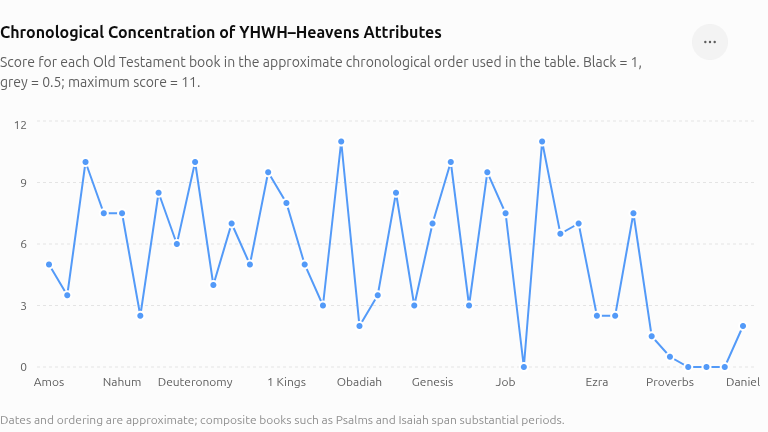
That makes something clearer than the black/grey/white matrix does: there is a downward tendency, but emphatically not a smooth one. There are enormous peaks throughout the middle of the sequence—Ezekiel, Exodus, Numbers and especially Psalms.
The final section is different. After Chronicles, the line increasingly hugs the bottom, interrupted chiefly by Joel. So the visual impression of fading is not imaginary.

The first three periods are remarkably stable: 60.9% → 57.0% → 54.1%. There is no dramatic progressive disappearance of the physical YHWH complex during that long period.
Then it collapses to 16.7% in the late Persian/Hellenistic material.
That changes our interpretation considerably. The original 39-book graph gave the impression of a long, erratic decline. The grouped calculation suggests something more specific: relative persistence followed by a pronounced late decline.
Note: The chronology used here is necessarily approximate. Many Old Testament books contain material composed or edited over extended periods, and their dates remain disputed. Psalms has been excluded from the chronological calculation because the collection spans several centuries and cannot reasonably be assigned to a single period. The graph should therefore be read as showing a broad chronological tendency rather than a precise historical progression.
For a modern Christian reader, heaven readily means a transcendent, non-material realm: the destination of the saved, the dwelling of God, something outside ordinary physical geography. Once that meaning is assumed, a statement such as “YHWH came down from heaven” is almost automatically understood metaphorically.
But the Hebrew שָׁמַיִם (shamayim) has a much more concrete spatial range. Depending upon context, it can denote the sky, the region of clouds and weather, the place where birds fly, the region of the sun, moon and stars, or the heavens as the region above the earth. The boundary between our modern concepts of sky, outer space and heaven simply isn’t built into the word in the same way.
If we temporarily replace the theological word heaven with the spatial expression “the region above the earth,” some familiar sentences sound quite different:
YHWH is in the region above the earth.
YHWH comes down from the region above the earth.
YHWH travels through the region above the earth.
YHWH rides upon clouds.
YHWH approaches particular geographical locations from above.
None of that demonstrates that YHWH was an astronaut. But it exposes something that the conventional English vocabulary can conceal: the texts repeatedly describe movement within a spatial universe.
Much of our thinking about God has been confused by what we have come to understand by the word heaven. For the biblical writers, heaven was not necessarily the immaterial realm that the word suggests to us. It was also, quite literally, what lay above the earth. Once that distinction is recognised, descriptions of YHWH descending, approaching, travelling, riding upon clouds and appearing amid fire, light, noise and physical disturbance acquire a rather different character. They do not prove that YHWH was an astronaut. They do, however, leave us with the intriguing possibility that we have been asking what these ancient writers meant before paying sufficient attention to what they actually said.