
Suppose the events surrounding the death of Jesus had been reported by a modern tabloid. Stripped of two thousand years of Christian familiarity, the story might have looked something like this. MESSIAH CRUCIFIED Galilean preacher executed after Jerusalem unrest A Galilean preacher hailed by his followers as the promised Messiah was crucified by the Romans …
Month: August 2026
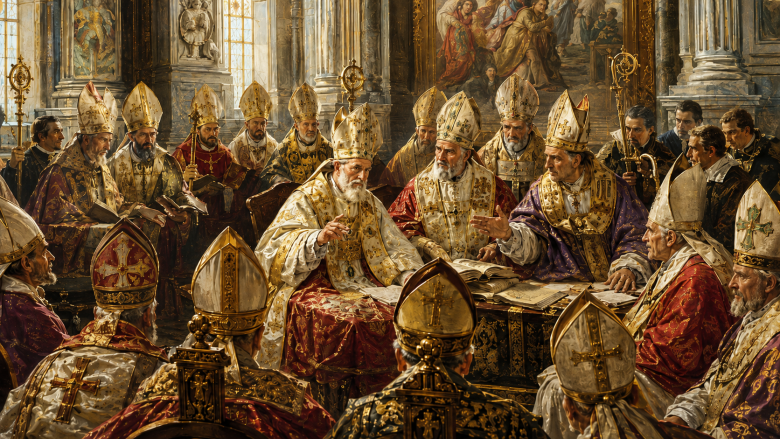
How did a Jewish teacher executed around 30 CE become, within a few centuries, the centre of an elaborate theology defining him as fully divine? This article follows the development from Paul and the Gospels through Marcion, Irenaeus, Arius, Athanasius, Constantine and the great councils of the fourth and fifth centuries.
What happens to the memory of a charismatic teacher after his death? From Jesus to Osho, the growth of institutions, rival interpretations and later doctrines may be less surprising than it first appears.

John Roddam Spencer Stanhope, Eve Tempted, 1877. Manchester Art Gallery. “The devil can cite Scripture for his purpose.An evil soul producing holy witnessIs like a villain with a smiling cheek,A goodly apple rotten at the heart.O, what a goodly outside falsehood hath!” Shakespeare’s The Merchant of Venice, Act 1, Scene 3 People continually tried to …
Joshua’s declaration, “As for me and my house, we will serve YHWH,” comes from a religious world very different from the universal, philosophical conception of God found in Acts 17. How did the national god of Israel become identified with the all-loving, all-merciful God of later Christianity?

How did medieval Europe, with small populations and limited technology, build thousands of churches and great cathedrals? The answer lies not only in wealth and belief, but in the Church’s inheritance of Roman structures of hierarchy, administration and social control — structures which helped shape European society long after the Middle Ages.

From John Taylor’s surveying and engineering to the Enlightenment’s struggle with metaphysics, this reflection asks a simple question: how much do we really need to know about ultimate reality in order to live intelligently within it? Physics learned to measure, predict and act without waiting for metaphysical certainty. Perhaps we can do the same.

Privilege is not necessarily a moral offence. Advantage may arise from talent, opportunity, inheritance or sheer good fortune; the problem begins when it hardens into entitlement, exclusion or contempt. A flourishing society should neither flatten difference nor pretend that human abilities are interchangeable. It should allow talent to develop while remembering that fortune is unstable and privilege should be handled with humility.
Privilege has never been static. Wealth, education and influence create advantages that can be inherited, while meritocracy seeks to open advancement to those with ability regardless of background. From Victorian reform and grammar schools to modern debates over DEI, the enduring question is how far circumstances should influence judgement without becoming a substitute for demonstrated competence

Women in priesthood should mean more than allowing women to occupy roles once reserved for men. What might women bring to priesthood precisely as women — nurture and tenderness, but also embodiment, fecundity, sensuality and the sheer erotic power of the feminine?