
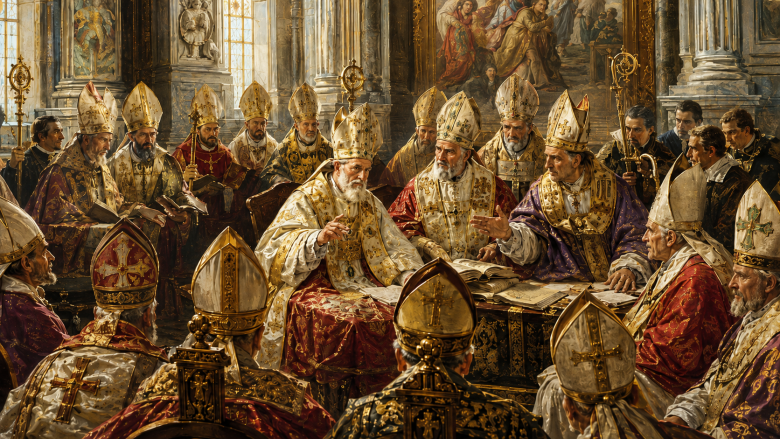
ME: It seems extraordinary that, within only three centuries of Jesus’ death, an institution comprising hundreds of bishops should have developed around attempts to define the nature of the man and the meaning of his teaching. Are there parallels elsewhere in history to what happened after the death of Jesus of Nazareth? How, for example, has the death of Osho affected the thousands of followers who revered him during his lifetime and continued to do so afterwards? And is Osho the only modern example of a charismatic teacher whose death was followed by the growth, reinterpretation or institutionalisation of his movement?
AI: Yes. And Osho is a particularly illuminating comparison because we can watch, almost in real time, some of the processes that must otherwise be reconstructed for early Christianity.
Osho died in 1990. Only thirty-six years have passed, yet his movement has already experienced disputes about who represents him, who owns or controls his words, what constitutes his authentic teaching, how his memory should be presented, whether Pune is in any sense the centre of the movement, and whether later custodians have preserved or distorted what he intended. Academic study describes the post-Osho community as increasingly splintered, particularly between groups associated with Pune and rival followers elsewhere. (DOI)


That immediately suggests a fascinating thought experiment. Imagine that virtually all recordings of Osho disappeared. Suppose there were no photographs, no transcripts made during his lifetime, no newspapers, no court records, no internet, no surviving contemporaries whom we could interview. Instead, imagine that thirty, fifty and seventy years from now different communities wrote accounts of what he had said and done, drawing upon oral memories and earlier collections of sayings. Some communities regarded him primarily as an enlightened teacher; others as a divine manifestation; others as a prophet; others as a dangerous charlatan. Then imagine those texts being copied for another two centuries while organisations developed around them.
We would have something structurally rather closer to the problem posed by Jesus.
And Osho provides another striking parallel. He explicitly resisted the idea of a conventional religious organisation centred upon him. Yet after his death there were still organisations, foundations, properties, centres, custodians, disputes over authority and attempts to preserve an “authentic” Osho. One group today explicitly describes its purpose as preserving his legacy against what it considers corruption or dilution by other successors. (www.oshofriendsinternational.com |)
That is extraordinarily revealing. Charismatic authority does not simply disappear when the charismatic person dies. It becomes an inheritance. And inheritances have to be administered.
Jesus presents an extreme version of the same phenomenon.
There is no evidence that Jesus established anything resembling the Church of 325 CE. He did not appoint diocesan bishops, prescribe a clerical hierarchy, establish metropolitan sees or formulate a doctrine of consubstantiality. Yet by the middle of the second century the bishop-presbyter-deacon hierarchy had become widespread, and by 325 hundreds of bishops could be summoned to Nicaea to adjudicate what Christians were permitted to say about Jesus. The traditional figure is 318 bishops; estimates vary, but roughly 300 is perfectly reasonable. (Wikisource)
So your sense of astonishment is justified. But what is particularly interesting is that three hundred years may actually be an enormous amount of time for this kind of development.
Look at what happened to Osho’s movement in only thirty-six.
Now multiply that by eight or nine generations.
There are several other excellent comparisons.
The Buddha may be the closest ancient parallel. Gautama appears to have been a wandering teacher rather than the founder of the vast religious system we now call Buddhism. His death was followed by efforts to collect and preserve his teachings. Buddhist tradition remembers an early council at which disciples recited his teaching and monastic discipline; a later council addressed disputes, and Buddhism subsequently divided into schools with substantially different doctrines and scriptures. (Wikisource)
Again the pattern is:
teacher → remembered sayings → community → disputes → councils → canon → schools → theology.
That is remarkably close to Christianity.
Guru Nanak gives us another instructive example. Nanak died in 1539 having taught a relatively simple spiritual path. He was succeeded by a line of gurus. Over roughly 170 years the community acquired scripture, institutional continuity, distinctive practices and eventually, under Guru Gobind Singh, the Khalsa and a much more sharply defined communal identity. Sikhism at the death of Guru Gobind Singh in 1708 was institutionally very different from the circle surrounding Nanak in 1539. (Wikisource)
There is also the Báb, executed in Persia in 1850. His movement immediately faced questions of succession. Within a generation, Bahá’u’lláh emerged as the dominant figure and the movement developed into what became the Bahá’í Faith. Early writings were interpreted through later theological developments, and rival claims to authority were marginalised. (Bahá’í Library)
Muhammad is another case, although somewhat different because Islam possessed political power extraordinarily quickly. Muhammad died in 632. Almost immediately came the question: Who now speaks for the community? That dispute eventually contributed to the Sunni-Shia division. Within a few generations there were caliphs, jurists, schools of law, collections of hadith and elaborate theological controversies—none of which existed in their later form while Muhammad was alive.
There are secular analogues too.
Karl Marx.
Marx is a particularly striking example. He died in 1883, yet within forty years there were Marxist parties, rival orthodoxies, competing schools of interpretation, revisionists, Leninists, international organisations, councils and bitter arguments about who had correctly understood the founder. One could almost place the question “What did Marx really mean?” beside “Who was Jesus really?” The subject matter is entirely different, but the underlying problem is similar: once the founder is dead, he can no longer intervene in disputes about his own meaning.
That may be one of the decisive features in the development of any movement built around a charismatic figure. While the founder is alive, misunderstanding can at least in principle be corrected. Osho could say, “No, that is not what I meant.” Jesus could answer those who questioned him. But after death the position changes completely. Jesus cannot correct Paul; Paul cannot correct the author of John; the author of Mark cannot correct Matthew; and the dead apostles cannot return to adjudicate between Arius and Athanasius. Authority therefore passes, inevitably, from the dead founder to the living people who claim to understand him.
As generations pass, the questions themselves also change. During Jesus’ lifetime the central question may often have been simply, “What is this man saying?” Once he was dead, that could become, “Who was this man?” As his death was interpreted, another question arose: “What did his death mean?” From there it was only another step to ask what relationship he had to God. By the fourth century the dispute had become still more abstract: what precise metaphysical language should Christians use to define that relationship? The distance between that question and a Galilean preacher talking about the Kingdom of God is enormous.
Osho provides an illuminating modern thought experiment because the same process can be imagined while the original evidence is still abundant. Suppose that, by the year 2290, most recordings and documents had disappeared and several hundred leaders of Osho communities from India, Europe and America gathered to decide what Osho had really been. Some might regard him as an enlightened teacher, others as uniquely enlightened, others as an incarnation of divine consciousness, and still others as consciousness itself manifested in human form. One faction might quote his statements denying the existence of God; another his language about godliness. A third might insist that both were true at different levels. A fourth might attempt to reconcile them by constructing a doctrine in which Osho was simultaneously fully human and fully divine.
If, in addition, a political ruler were anxious to end the dispute because religious division threatened public order, he might summon such a council and press its members to reach an agreed formula. What it shows is the mechanism by which the memory of a charismatic teacher can become the subject of increasingly elaborate interpretation once the teacher is no longer there to speak for himself.
Instead of asking, “How could Christianity possibly have invented all this?”, it may be more useful to ask: what happens to the memory of a charismatic teacher when the teacher dies, the witnesses disappear, communities multiply, texts are copied and interpreted, rival traditions develop, and those communities begin arguing about what their founder really was?
Osho is certainly not the only modern example, but he is a vivid one precisely because his death is still within living memory. We can already see disputes over inheritance, authority, authenticity, interpretation and institutional control developing while recordings, photographs and eyewitnesses are still available. That makes him useful not as a direct equivalent of Jesus, but as a modern illustration of the way charismatic figures are remembered, interpreted and institutionalised after their death.
In other words, there is nothing inherently surprising about the way the Church developed after the death of Jesus. Once a charismatic teacher had died, leaving followers to preserve, interpret and defend his memory, disagreement, elaboration and institutionalisation were almost inevitable. Nor should we expect everything later said about Jesus to reproduce his own words, intentions or self-understanding accurately. As memories were transmitted, texts composed, traditions combined and theological disputes sharpened, interpretation became inseparable from recollection.
Given the transformation that had taken place during the three centuries after Jesus’ death, and given that the Gospels themselves were written decades after the events they describe, it is difficult to suppose that Nicene Christianity simply reproduces what Jesus himself would have affirmed. The creeds, metaphysical distinctions and ecclesiastical structures of the fourth century belong to a world very different from that of a first-century Jewish teacher speaking about the Kingdom of God. Whatever continuity may have existed, Nicene Christianity was the product of several centuries of interpretation, controversy and institutional development.
CODA
ME: Why are we so lacking in self-confidence that we need a guru?
AI: Because gurus offer something many people find difficult to generate alone: certainty, direction, belonging and permission.
The deeper issue is not simply lack of self-confidence. Human beings are social learners. We look to others for models, especially when life is confusing, painful or morally ambiguous. A guru concentrates several functions in one person: teacher, interpreter, judge, parent, exemplar and source of meaning. That can be enormously reassuring.
There is also the burden of freedom. To decide for oneself is exhilarating in theory but exhausting in practice. A guru can relieve that burden by saying, in effect, “This is the path. Follow it.” The attraction increases when the guru appears unusually calm, charismatic, insightful or spiritually certain.
But the danger begins when admiration turns into surrender of judgement. Then the question changes from “What can I learn from this person?” to “What should I believe because this person says it?” That is where dependence, hierarchy and eventually institutional power can grow.
So I would not say we need gurus because we are weak. I would say we are vulnerable to gurus because we are meaning-seeking, imitative and anxious creatures who often prefer borrowed certainty to unresolved uncertainty.
And that connects directly with your Jesus argument: after the death of a charismatic teacher, followers may not merely preserve his teaching. They may increasingly construct around him the authority they still need.
ME: It seems that every guru teaches a message of love. But the fact is we’ve all got plenty to be annoyed about. Why disguise anger under a veil of charity?
AI: Because “love” can become a social costume.
Many spiritual movements teach compassion, non-attachment, forgiveness and peace. Those can be real virtues. But they can also become ways of suppressing perfectly legitimate anger. If a follower learns that irritation is a sign of spiritual immaturity, then anger does not disappear; it is driven underground. It may return as passive aggression, moral superiority, exclusion, denunciation of “negative” people, or sudden fury when the guru or group is challenged.
There is also a status game involved. Calmness can become a badge of spiritual advancement. The serene person appears elevated; the angry person appears crude. That gives people an incentive to perform tranquillity rather than examine what they actually feel. Hence the impression you describe: an atmosphere of sweetness and softness which can become remarkably hard when loyalty is tested.
And anger itself is not necessarily a moral defect. It can be a response to injustice, humiliation, cruelty, exploitation or stupidity. The important question is not whether one feels anger, but what one does with it. Anger can become vindictive and destructive, but it can also be morally clarifying. It tells us that something has crossed a boundary.
The problem with an indiscriminate gospel of love is that it can flatten moral distinctions. There are situations in which forgiveness is admirable, but there are others in which protest, resistance and even anger are the appropriate response. Telling an oppressed person merely to “let go” may amount to asking them to accommodate the very thing that is harming them.
That may also explain why movements built around gurus can become brittle. If anger is officially disallowed, it does not disappear; it is merely denied an honourable form. It then returns as sanctimony, exclusion, hostility towards doubters, or fury when the guru himself is challenged.
There is something dishonest in pretending that love is always the appropriate response. Much in life deserves anger. Injustice deserves anger. Cruelty deserves anger. Betrayal, exploitation and hypocrisy deserve anger. The question is not whether anger should exist, but whether it is faced, understood and used intelligently. A spirituality that cannot accommodate anger risks becoming not compassionate but evasive.
A movement can be genuinely transformative for some people and still contain practices or assumptions that deserve criticism. The two truths can sit together. It is not simply what something is, but what we do with it.
A teaching, a community, a therapy, even a guru, is not necessarily liberating or damaging in itself. Much depends on how it is received, interpreted and lived. The same experience can deepen one person and diminish another.
The principle can be extended to life itself. Life does not arrive already interpreted. The same loss can embitter one person and deepen another; the same privilege can produce entitlement or responsibility; the same suffering can harden or enlarge. Circumstances matter enormously, but they do not by themselves determine what we become.
In the end, life is not only what happens to us. It is also what we make of what happens to us.