
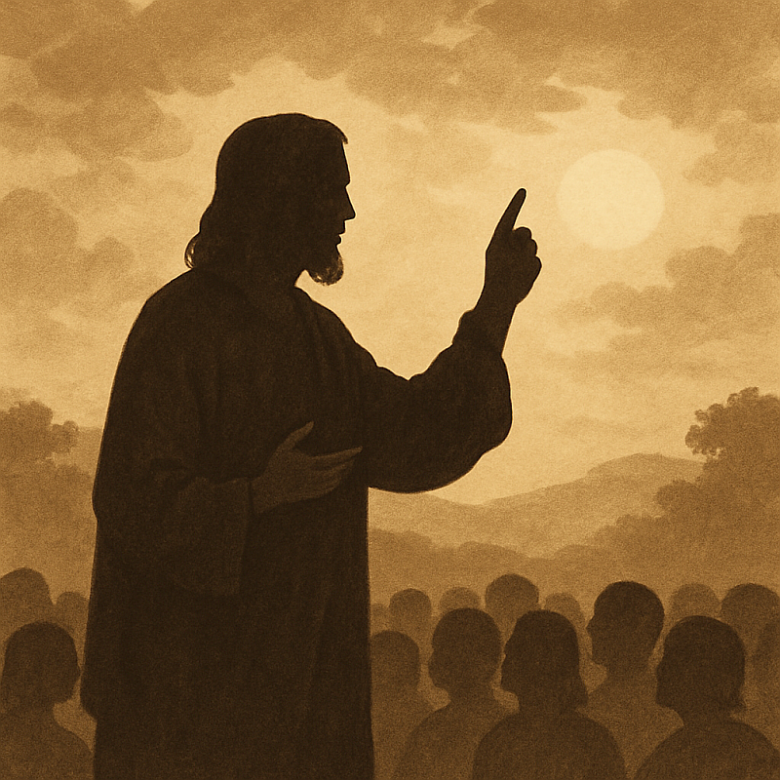
Jesus feels modern not because of theology, but because of his fearless moral clarity. Once we strip away the metaphysical layers, the radical teacher of the Synoptics emerges: a compassionate social philosopher who confronted wealth, hierarchy, exclusion, and fear. This article explores how the historical Jesus differs from the later “metaphysical Christ,” and why his vision still exposes the moral fault-lines of our own age.
A reflective essay viewing the Bible as an allegory of consciousness — where Abraham, Israel, and Jerusalem represent stages of inner growth, and the ancient covenant reveals itself as a timeless moral psychology of the human soul.
A reflection on the inner stillness that frees us from self-rejection and restores our capacity to love. Drawing on Jesus’ teaching of the Shema and contrasting the Western vision of wholeness with the Zen ideal of self-effacement, this meditation explores awareness as a natural state — a flight of the spirit in peace and light.
The lotus rises pure from the mud, uniting science and symbol, matter and mind. This reflection explores how the flower’s ancient imagery bridges the two magisteria of human understanding — the measurable and the mysterious.
Meditation does not mean emptying the mind. It means clearing space to think — a discipline of clarity that the Western tradition saw as sacred reasoning, not blankness.
A reflection on parenting, morality, and the teaching of Jesus — showing how the true measure of life lies not in worldly success but in moral fruitfulness. Wealth and compassion need not be opposed, but reconciled through the law written in the heart.
For centuries, religion has offered meaning and comfort, but also control. Today many still hunger for faith, yet find the old stories impossible to believe. This short reflection asks whether we can keep what was best in religion — compassion, courage, and care — without pretending to accept what no longer persuades reason. It argues that meaning, not miracle, must become the new ground of faith.
A historical and psychological journey through the making of biblical literalism — how faith that once saw Scripture as symbol and wisdom became bound to words on a page. This essay traces the shift from Origen and Augustine to American fundamentalism, revealing how the need for certainty replaced the quest for understanding.
Modern evangelicalism is not an ancient faith but a twentieth-century invention. Born in the anxiety of 1930s America, it fused personal emotion, mass media, and nationalism into a new religious identity. What began as revival became a system of control — replacing faith as awareness with belief as submission.
The Christian God is not the Father we never had, but the Father we must become. This essay explores how Jesus’ teaching can be read as a psychological process of inner reconciliation — a journey from dependency to awareness, from outer authority to inner wholeness.
Tags: Jesus, theology, psychology, Jung, Tillich, Bultmann, Bonhoeffer, consciousness, metanoia, inner life