The early chapters of Genesis are often read in isolation, as though they dropped from heaven complete and independent. But archaeology and the decipherment of cuneiform have shown that Genesis belongs to a much older world of stories, symbols, flood traditions, divine councils, long-lived ancestors, creation from earth, and gods who shape the destiny of human beings.
The Bible is not weakened by the discovery of older Mesopotamian parallels. On the contrary, those parallels give Genesis a firmer historical setting. They show that the biblical writers were not inventing in a vacuum. They were working within a vast ancient Near Eastern inheritance, reshaping older material into Israelite theology.
The question is not simply whether Genesis is “original”. Few ancient texts are original in that modern sense. The better question is: why do several ancient stories, written in different forms and at different times, preserve the same central pattern?
That pattern is clear enough. Human beings are made from earthly substance by divine or more-than-human agency. They live in a world where the boundary between human and divine is unstable. There are beings greater than man. There is knowledge not freely given. There is a flood. There are survivors. There are long lives before the flood and shortened lives after it. There is memory of an earlier age, larger and stranger than ordinary history.
The details change but the central structure remains.
- Sumer, Mesopotamia, and the Birthplace of Civilisation
Sumer was the civilisation of southern Mesopotamia, in what is now southern Iraq. The word Mesopotamia itself means “between rivers”, referring to the land between the Tigris and Euphrates. This region matters because it is one of the great birthplaces of urban civilisation: irrigation, city-states, temples, writing, law, organised kingship, mathematics, trade, and literary tradition.
Settlement in the region goes back well before the classic Sumerian period. The Ubaid culture is usually dated from around the fifth millennium BCE. Sumerian civilisation proper flourished especially in the fourth and third millennia BCE. By the late fourth millennium BCE, cuneiform writing had begun to develop, and by the middle of the third millennium BCE clay tablets were being used for economic, political, religious, literary, and scholarly texts.
This is important because the biblical material in Genesis emerged much later than the first Sumerian cities and tablets. The stories in Genesis may preserve very old traditions, but the Hebrew text as we have it belongs to a later world. It is therefore not surprising that Genesis shares themes with older Mesopotamian material. The Israelites lived downstream, culturally speaking, from a much older river of Near Eastern story.
- How Cuneiform Was Read
The recovery of Mesopotamian literature depended on the decipherment of cuneiform. This was not guesswork. It was a long scholarly process.
Cuneiform was written by pressing wedge-shaped signs into clay tablets. The system began in Sumer but was later adapted for several languages, including Sumerian, Akkadian in its Babylonian and Assyrian forms, Hittite, and others. The same script could therefore operate in very different linguistic settings, which made decipherment more difficult. We need only think of the Roman alphabet familiar to us today. The same script is used to write mutually incomprehensible languages: French, German, Dutch, Norwegian, and many others.
The key breakthrough came from the Behistun inscription in Persia, carved on a cliff face in about 520–518 BC during the reign of Darius I. Like the Rosetta Stone for Egyptian hieroglyphs, Behistun preserved the same royal inscription in several languages. The decipherment of cuneiform was advanced above all by Henry Rawlinson (1810–1895), Edward Hincks (1792–1866), and Jules Oppert (1825–1905). Working comparatively, they and others gradually unlocked the script, first through Old Persian and then through Babylonian/Akkadian. Once Akkadian could be read, scholars were able to move further into the Sumerian material, helped by bilingual tablets, lexical lists, scribal school texts, repeated formulae, proper names, and comparison across large bodies of tablets.
This matters because claims about cuneiform texts should be testable. A serious claim should give tablet numbers, museum references, transliterations, translations, and scholarly discussion. We do not have to accept every speculative modern reading simply because cuneiform is difficult. But neither should we dismiss the tablets. They are real witnesses to an ancient world.
- George Smith and the Flood Tablet
The modern comparison between Genesis and Mesopotamian literature begins dramatically in the nineteenth century. In 1872, George Smith, an assistant at the British Museum, identified a tablet containing a flood story closely parallel to the biblical account of Noah.
The tablet was not a “Sumerian Eden tablet” in any simple sense. It was a Neo-Assyrian tablet from Nineveh, copied in the seventh century BC as part of the Epic of Gilgamesh tradition. Its importance lies not in proving a direct Sumerian source for Genesis, but in showing that stories of flood, divine-human conflict, mortality, and lost wisdom circulated widely across the ancient Near East. Here was an ancient Mesopotamian flood story, written in cuneiform, whose details resembled Genesis: divine warning, a great flood, a boat, the preservation of life, birds sent out after the waters began to subside, and survival after catastrophe. Genesis should therefore be read not in isolation, but as part of a much older world of shared images, myths, and moral questions.
That discovery changed the way Genesis had to be read. The flood story was not unique to the Hebrew Bible. It belonged to a wider Mesopotamian world.
This does not mean that the biblical story was simply copied. It means that Genesis took part in a long tradition of flood memory and flood myth. The biblical writers inherited material already known in the ancient Near East, but they reshaped it over time within their own moral and theological world. The differences are as important as the similarities. They suggest not a simple act of borrowing, but a long process of transmission, retelling, and reinterpretation. By the time the story reached its biblical form, it had been reshaped for a different religious and moral setting.
- The Main Mesopotamian Texts
Several Mesopotamian texts are important for comparison with Genesis.
The Sumerian King List is usually dated, in its written forms, to the late third or early second millennium BCE. It is a written list of kings, cities, and reign lengths before and after the Flood. It begins with the claim that kingship “descended from heaven”, and it gives astonishingly long reigns to the earliest kings. Alulim, the first king, is credited with 28,800 years at Eridu; Alaljar followed with 36,000 years; and En-men-lu-ana is given 43,200 years. Altogether, the eight kings before the Flood are said to have ruled for 241,200 years. These are the figures given by the text. They do not fit what we ordinarily know of human life, with its threescore years and ten.
The Eridu Genesis, sometimes called the Sumerian Flood Story, survives in fragmentary form. The surviving copies are generally associated with the Old Babylonian period, around the seventeenth or sixteenth century BCE, though the traditions behind it may be older. It links creation, the founding of cities, kingship, and the flood.
The Atrahasis Epic is an Akkadian text, usually dated to the Old Babylonian period, around the eighteenth or seventeenth century BCE. It is one of the most important Mesopotamian creation-and-flood accounts. It explains the creation of humanity in relation to divine labour, rebellion among the gods, population growth, and the flood.
The Epic of Gilgamesh exists in several versions. Gilgamesh himself may reflect an early dynastic king of Uruk, perhaps around 2600 BCE, though the literary epic took shape much later. Old Babylonian versions existed by the second millennium BCE. The Standard Babylonian version, known from the library of Ashurbanipal at Nineveh, belongs to the first millennium BCE. Tablet XI contains the famous flood story told by Utnapishtim to Gilgamesh.
In the Gilgamesh flood story, Utnapishtim tells how the gods decided to destroy humanity with a great flood. The god Ea secretly warned him and told him to build a large boat, bringing into it his family, craftsmen, animals, and seed or living things. The flood came with overwhelming force and destroyed the world outside the vessel. After the waters subsided, Utnapishtim released birds to discover whether dry land had returned. When the boat finally came to rest, he offered a sacrifice. The gods gathered round the offering, and Utnapishtim and his wife were granted a special kind of immortality.
Genesis, by contrast, belongs to the Hebrew Bible and reached its final form much later than the earliest Sumerian traditions. Its sources, oral and written, are debated. What matters here is not a precise date for final composition, but the broad historical fact that Genesis stands after centuries of Mesopotamian storytelling about creation, divine beings, early humanity, kingship, and flood.
The time gap is important. We are not comparing one neat text with another neat text. We are comparing fragments, traditions, copies, recensions, and translations, produced in different settings and preserved unevenly. The similarities between Gilgamesh and Genesis do not prove simple copying. They show that the biblical flood story belongs to a wider world of ancient Near Eastern flood narratives. How far back these stories go, and what older memories may lie behind them, cannot be known with certainty.
- The Main Figures
The names can be confusing because different traditions preserve different figures.
Enki, also called Ea in Akkadian tradition, is the god of wisdom, freshwater, craft, magic, and often human preservation. He is frequently the god who helps humanity, or at least prevents its total destruction. In flood traditions he warns the flood survivor, sometimes indirectly, so that life may continue.
Enlil is often associated with command, authority, wind, storm, kingship, and divine decision. In several Mesopotamian stories he is the god who supports destructive action against humanity. He is not simply “evil”, but he often represents divine order, control, and severity.
Ziusudra is the Sumerian flood survivor. His name belongs to the Sumerian flood tradition.
Atrahasis, whose name means something like “exceedingly wise”, is the flood hero in the Akkadian Atrahasis Epic.
Utnapishtim is the flood survivor in the Epic of Gilgamesh. He tells Gilgamesh how he survived the flood and was granted a special status afterwards.
Noah is the flood survivor in Genesis.
These names are not identical in a simple way, but they occupy comparable positions within related flood traditions. A flood is decreed. One man is warned. A vessel is built. Life survives. The waters recede. A new age begins.
- Humans Made from Clay and Divine Substance
The creation of humanity in Genesis has Mesopotamian parallels.
In Genesis, God forms man from the dust of the ground and breathes into him the breath of life. The image is simple and powerful: humanity is earth animated by divine breath.
In the Atrahasis Epic, the creation of humanity is more complicated. The gods are burdened by labour. Lower-ranking gods complain about the work imposed on them. The solution is to create human beings to carry the burden instead. In one version, a god is killed and his flesh and blood are mixed with clay so that humanity is formed from earth and divine substance.
This is not the same as Genesis, but the comparison is striking. In both worlds, humanity is made from earthly material and given life through divine involvement. In Atrahasis, human beings are created to work for the gods. In Genesis, humanity is placed in a garden “to dress it and to keep it”. The tone is different, but the themes overlap: earth, divine agency, labour, and human purpose.
Genesis simplifies and moralises the older pattern. It removes the noisy world of many gods, divine fatigue, rebellion, and compromise. Instead, one God creates man deliberately and places him within an ordered world.
That is not necessarily a loss of meaning. It is a theological transformation.
- Enki, Enlil, and the Divine Dispute over Humanity
Mesopotamian stories often present the gods as divided. This is one of the most important differences between them and Genesis.
In Atrahasis and related flood traditions, humanity becomes a problem. Humans multiply. Their noise or presence disturbs the gods. Divine patience breaks down. The flood is not simply a moral judgement in the later biblical sense. It arises from a troubled relationship between gods and humanity.
Enlil moves towards destruction. Enki/Ea preserves life.
Genesis does not preserve the open quarrel among gods found in Mesopotamian flood stories. Yet the plurality has not vanished altogether. The Hebrew word Elohim is plural in form and can mean “gods” or “divine beings”, though when used of Israel’s God it is often translated simply as “God” and joined to singular verbs. Genesis also preserves plural expressions such as “let us make” and “one of us”. The text therefore belongs to an older and more complex religious world than later doctrinal monotheism suggests. What has changed is that the open conflict among divine beings, so prominent in Mesopotamian flood stories, is no longer narrated directly.
That gives the biblical story greater theological intensity. It does not simply say, “one god wanted to destroy and another god wanted to save.” It says that judgement and mercy both belong to the one God with whom humanity must reckon.
- The Flood Hero: Ziusudra, Atrahasis, Utnapishtim, Noah
The flood survivor appears under different names in different traditions.
In Sumerian tradition he is Ziusudra. In the Atrahasis Epic he is Atrahasis. In the Gilgamesh flood story he is Utnapishtim. In Genesis he is Noah.
The names differ, but the pattern is recognisable. A great flood is decreed. One man is warned. A vessel is built. Life is preserved. The flood comes. The waters recede. A new beginning follows.
The differences also matter. In Gilgamesh, the flood story is part of a meditation on mortality. Gilgamesh is searching for a way to escape death, and Utnapishtim’s story shows him that immortality is not available to ordinary human beings.
In Atrahasis, the flood is connected to divine disturbance and the management of humanity. The gods have created humans, but the human population becomes troublesome.
In Genesis, the flood becomes a moral crisis: violence fills the earth; judgement falls; Noah is preserved; covenant follows.
The central story is recognisably similar. The interpretation changes.
The shared story suggests an older memory or inherited narrative pattern. The changed details show how each culture interpreted that memory. The essential truth may not lie in every detail of serpent, fruit, boat, mountain, or number. It may lie in the core pattern: humanity in contact with beings greater than itself; a divine or more-than-human decision affecting human destiny; catastrophe; survival; and a new beginning.
- The Sumerian King List and Long Lives Before the Flood
The Sumerian King List is especially important because of its pre-flood kings and their extraordinary reigns.
It begins:
“After the kingship descended from heaven, the kingship was in Eridug.”
It then lists rulers whose reigns last tens of thousands of years: Alulim rules for 28,800 years; Alaljar for 36,000 years; En-men-lu-ana for 43,200 years; and so on. Then the flood comes. After the flood, kingship descends again, and the reign lengths gradually become more ordinary.
This is not history in the modern sense. The Ashmolean Museum describes the King List as a combination of myth, legend, and historical information. But that is precisely why it matters. It shows that ancient Mesopotamians imagined the pre-flood world as different from the world afterwards.
Genesis preserves a similar but reduced pattern. Adam lives 930 years. Seth lives 912. Enosh lives 905. Methuselah lives 969. Noah lives 950. These ages are not tens of thousands of years, but they belong to the same world of thought: before the flood, human life was longer, larger, and nearer to the divine order.
After the flood, biblical lifespans decline. The long-lived patriarchs gradually give way to more ordinary human scale.
The parallel should not be overstated. The Sumerian King List is concerned with kingship and dynastic succession. Genesis is concerned with ancestry, creation, fall, violence, flood, and covenant. But both preserve the idea that the earliest age of humanity was not like the present age and both traditions remember a pre-flood age marked by extraordinary longevity.
- Eden, the Plain, and the Garden
The word “Eden” may have a Mesopotamian background. Some scholars connect it with the Sumerian word edin, meaning “plain” or “steppe”, though the connection with the Hebrew Eden should be made cautiously.
What can be said is this: the Eden story belongs to the same ancient Near Eastern world of thought as the Mesopotamian stories. It shares their concern with origins, divine-human boundaries, lost access to life, wisdom, mortality, and the difficult place of human beings within the created order. Genesis places Eden in relation to rivers, including the Tigris and Euphrates. Without identifying Eden simply with Mesopotamia, this association places the story near the world of irrigation, fertile alluvium, city-states, temple economies, and early writing.
The garden is not merely decorative. It is a place of life, work, prohibition, knowledge, testing, and exclusion. It contains the tree of life and the tree of the knowledge of good and evil. After the human beings eat, they are expelled and prevented from reaching the tree of life.
This has often been read as a story about sin. It is that, but it is also more. It is a story about the boundary between human beings and divine knowledge, between mortality and immortality, between innocence and consciousness. In this sense, Eden marks one of the decisive moments in the human story: the point at which the creature made to serve becomes self-aware. Humanity ceases to be merely obedient, instinctive, or automatic, and begins to know itself. From that moment onward, the human being must live with a divided nature: part animal, part consciousness; bound to the earth, yet aware of judgement, death, and possibility.
Man was not made simply to be part of nature in the same way as other forms of life. Something in him stands apart. He belongs to the animal world, yet he is not wholly contained by it. This alien element — consciousness, moral awareness, the capacity to judge himself — accounts for much of his torment. He is natural, but not merely natural; instinctive, but not merely instinctive. That is why his life is marked by struggle.
Mesopotamian parallels do not explain everything in Genesis. But they help show that biblical Eden belongs to a much older symbolic world: earth, water, divine command, forbidden knowledge, guarded access, mortality, and lost life.
This has often been read as a story about sin. More precisely, it is a story about disobedience: a command is given, a boundary is set, and the human being crosses it. But it is also more than that. Humanity is then confronted with its animal nature because it also carries something that seems alien to itself: consciousness, judgement, and the desire for godlike knowledge. The absurdity of the human condition lies in the fact that we are in conflict not only with ourselves — the earthly animal in tension with the divine — but with the natural world, which sustains us.
- The Serpent Is Not Yet Satan
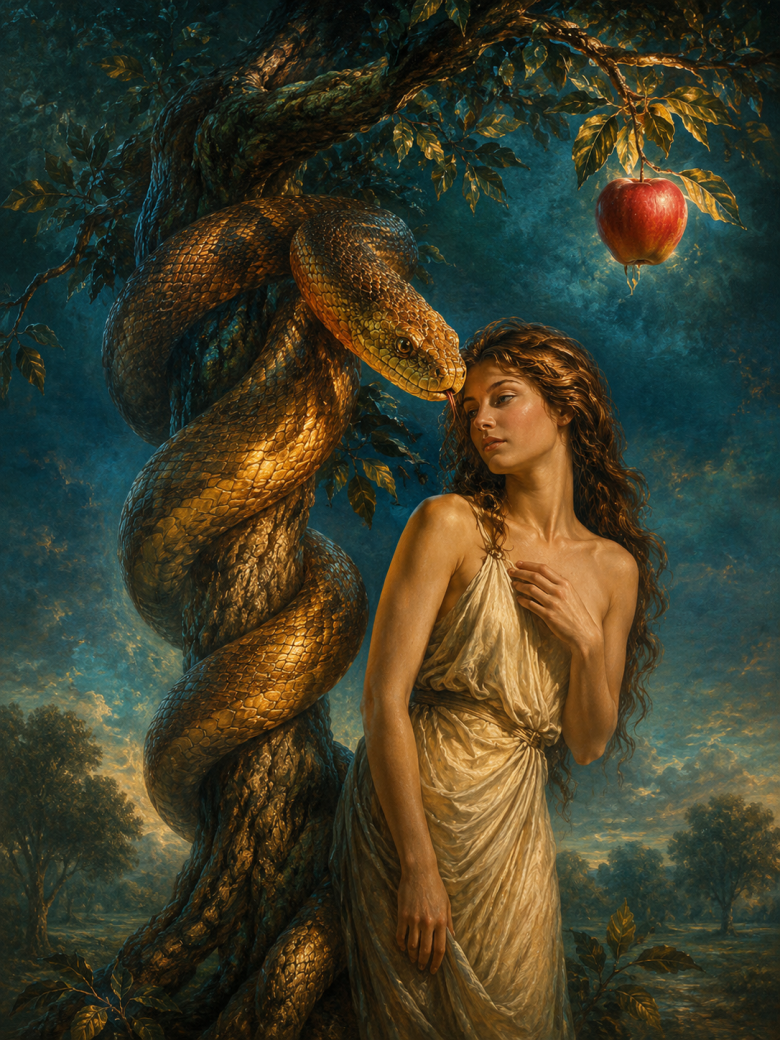
One important point is often missed. In Genesis itself, the serpent is not called Satan or the devil. He is described as subtle or crafty. Later Jewish and Christian interpretation identified the serpent with Satan, but that is not stated in the Eden narrative itself.
The serpent in Genesis is a figure of knowledge, temptation, ambiguity, and challenge. He tells the woman that eating the fruit will open their eyes and make them like gods, knowing good and evil. Disturbingly, that is partly what happens. Their eyes are opened.
Its coiled and sinuous form has long made the serpent a symbol of hidden life, danger, renewal, and forbidden wisdom. The serpent motif appears in both the Mesopotamian material and Genesis, though its precise meaning cannot now be recovered with certainty. If a modern reader sees a resemblance between the serpent’s twisting form and the DNA double helix, that resemblance can only be treated as a suggestive visual association.
Closer investigation of the historical background of the Eden story shows that it is more complex than the simple Sunday-school version. The serpent is not originally a horned devil. He stands at the boundary between blind obedience and conscious choice.
- Cherubim and the Guarded Boundary
Genesis ends the Eden episode with cherubim and a flaming sword guarding the way to the tree of life. Modern readers often imagine cherubim as small winged babies because of later art.
In the biblical world, cherubim are not the harmless child-angels of later art. In Genesis they guard the way to the tree of life; in the tabernacle and temple traditions they stand close to the divine presence, above the Ark and within the inner sanctuary. The wider ancient Near Eastern world also knew powerful hybrid guardian beings placed at gates, thresholds, and royal or sacred spaces. Cherubim therefore belong to the symbolic world of guardianship, holiness, and restricted access.
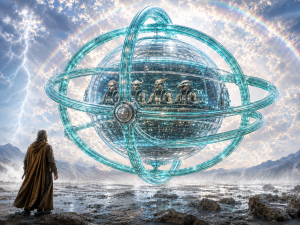
Cherubim appear again in Ezekiel’s visions, especially in Ezekiel 1 and 10. There they are strange composite beings associated with the divine chariot or throne. They have multiple faces, including human and animal features, and they are connected with wheels, movement, fire, eyes, and the overwhelming presence of divine glory.
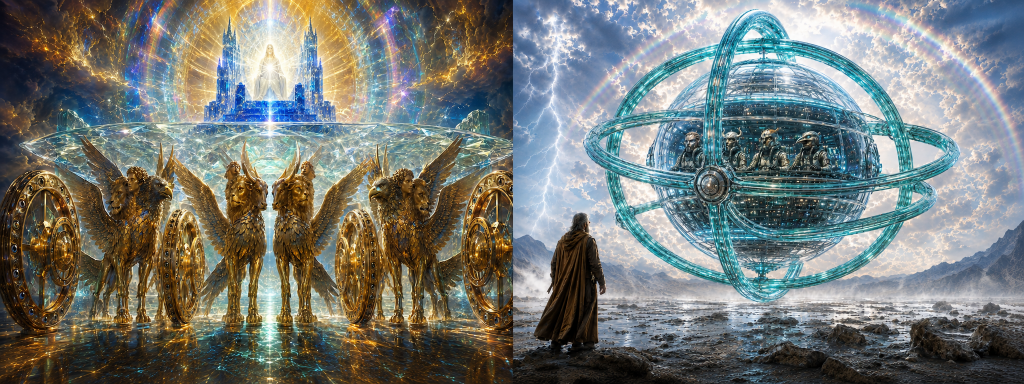
Ezekiel’s vision does not prove anything about space travel. It suggests that the Bible preserves strange and persistent images of guarded sacred places, overwhelming beings, fire, movement, and divine presence.
We may think here of the modern cargo cult. Human beings may preserve the outward form of something encountered but not fully understood. The result is neither exact memory nor pure invention, but an impression carried forward in symbolic form.
| Type of Psalm | Approximate Share | Emotional Tone |
|---|---|---|
| Lament / complaint / plea for help | 30–40% | Fear, danger, abandonment, enemies, punishment, divine silence |
| Thanksgiving | 10–11% | Rescue remembered, gratitude, fulfilled vows, public acknowledgement |
| Praise / hymn | 15–20% | Praise of Yahweh as creator, king, rescuer, and ruler |
| Royal / kingship / enthronement | 7–10% | King, dynasty, Zion, Yahweh’s reign |
| Wisdom / instruction | 5–8% | Moral reflection, righteous and wicked, law, conduct |
| Trust / confidence | 5–8% | Dependence, refuge, protection, waiting |
| Pilgrimage / Zion / temple / liturgical psalms | 5–10% | Worship, Jerusalem, temple, procession, communal identity |
| Mixed / hard to classify | Variable | Many psalms combine lament, praise, trust, petition, and thanksgiving |
- What Genesis Does with the Older Material
Mesopotamian stories often present a crowded divine world: gods quarrel, tire, rebel, compromise, make mistakes, and manage human beings for their own purposes. Humans may be created to relieve divine labour. Flood may result from annoyance, overpopulation, or divine conflict. Kingship descends from heaven and passes from city to city.
Genesis takes that world and changes its centre of gravity.
Genesis removes most of the visible divine machinery. The named gods of Mesopotamian myth no longer appear as a cast of beings arguing, plotting, and competing with one another. Yet Genesis is not simply the settled monotheism of later theology. The Hebrew Elohim remains plural in form, and the text preserves traces of an older complexity in phrases such as “let us make” and “one of us”. The story is now drawn under the authority of Israel’s God.
But we should not make the comparison too neat. We know little about the exact accuracy of either tradition. We are dealing with fragments, copies, memories, theological interpretations, scribal transmission, and cultural reshaping. What matters is that, written many centuries apart, the stories still preserve the same central structure.
That central structure may be more important than any one interpretation of it.
- Why This Matters
The Mesopotamian background gives Genesis a firmer historical setting. It shows that Genesis belongs to the real intellectual and religious world of the ancient Near East. It is not an isolated sacred tale floating above history. It is a text shaped in conversation with older traditions, older symbols, older fears, and older memories.
This does not settle the truth of the story. It does not tell us exactly what happened. It does not prove that the biblical account is literally accurate, nor does it prove that the Mesopotamian versions are literally accurate. We have fragments at best.
But the existence of parallel traditions is itself important.
The older stories help us see what Genesis is doing. They also suggest that behind the varied details lies a common remembered problem: humanity’s relation to powers greater than itself.
The serpent may change meaning. The flood hero may change name. The gods may become God. Divine quarrel may become moral judgement. Long pre-flood kings may become long-lived patriarchs. But the underlying questions remain.
Where did humanity come from?
Why is human life bound to labour, suffering, knowledge, and mortality?
Why does human history seem to begin after a catastrophe?
Why do ancient peoples remember beings from above, divine command, forbidden knowledge, long lives, flood, survival, and renewed order?
These are not trivial questions.
- Conclusion
The value of the Mesopotamian material is not that it proves a modern theory about hidden laboratories, genetic engineering, or suppressed tablets. The value lies in what the tablets unquestionably show.
Mesopotamian texts contain older flood stories. They speak of humans formed from clay and divine substance. They imagine gods debating humanity’s fate. They preserve long pre-flood reigns and the idea that kingship descended from heaven. They give us Ziusudra, Atrahasis, and Utnapishtim before Noah. They show that Genesis is part of a wider ancient world.
Genesis belongs to a world older, stranger, and richer than most modern readers imagine. Its power lies not in being wholly detached from that world, but in the way it reshapes that inheritance into a moral and theological drama.
What is striking is not that the details differ. Of course they differ. Stories change as they pass through languages, cultures, priesthoods, scribal schools, and theological systems.
What is striking is that the central story remains.
The Bible is not the first word spoken in the ancient Near East. Genesis stands in relation to older Mesopotamian material: Sumerian, Akkadian, Babylonian, and Assyrian stories about creation, gods, early humanity, kingship, flood, lost life, and guarded access. The point is not to defend Genesis, nor to diminish it, but to read it historically. Its stories belong to a wider world of memory, symbol, power, fear, and explanation.