

Psalm 18 and 2 Samuel 22 are so close in wording, sequence and imagery that they are best treated as two textual versions of the same underlying composition rather than as independent witnesses. Both present YHWH through a dense cluster of recurring features: cloud, fire, smoke, thunder or violent noise, lightning or flashes, descent, aerial movement, shaking of the earth or mountains, projectiles such as arrows or hail, and chariot or cherub imagery.
Psalm 18 and 2 Samuel 22
Psalm 18 and 2 Samuel 22 are so close in wording, sequence and imagery that they are best treated as two textual versions of the same underlying composition rather than as independent witnesses. The central theophany is particularly striking when the corresponding passages are placed side by side.
| Psalm 18 | 2 Samuel 22 |
|---|---|
|
v. 7 The earth shakes and trembles; the foundations of the mountains are disturbed. |
v. 8 The earth shakes and trembles; the foundations of heaven are disturbed. |
|
v. 8 Smoke rises from his nostrils; consuming fire comes from his mouth; coals are kindled by it. |
v. 9 Smoke rises from his nostrils; consuming fire comes from his mouth; coals are kindled by it. |
|
v. 9 He bows the heavens and comes down; thick darkness is beneath his feet. |
v. 10 He bows the heavens and comes down; thick darkness is beneath his feet. |
|
v. 10 He rides upon a cherub and flies; he moves upon the wings of the wind. |
v. 11 He rides upon a cherub and flies; he appears upon the wings of the wind. |
|
vv. 11–12 Darkness and dense clouds surround him. |
v. 12 Darkness, gathering waters and thick clouds surround him. |
|
vv. 13–14 YHWH thunders from heaven amid hail and coals of fire. |
vv. 13–14 YHWH thunders from heaven amid coals of fire. |
|
v. 15 He sends out his arrows and lightning, scattering his enemies. |
v. 15 He sends out arrows and lightning, scattering his enemies. |
The importance of the comparison lies not merely in the recurrence of similar images, but in their sequence. In both passages the pattern runs: shaking → smoke and fire → descent → cherub and aerial movement → darkness and cloud → thunder and fire → arrows and lightning.
This cluster provides the reference profile for the wider comparison across the Old Testament: fire, cloud, smoke, thunder or violent noise, shaking, descent, aerial movement, lightning or flashes, projectiles, and chariot or cherub imagery.
The wording above is deliberately condensed rather than quoted from a particular English translation.
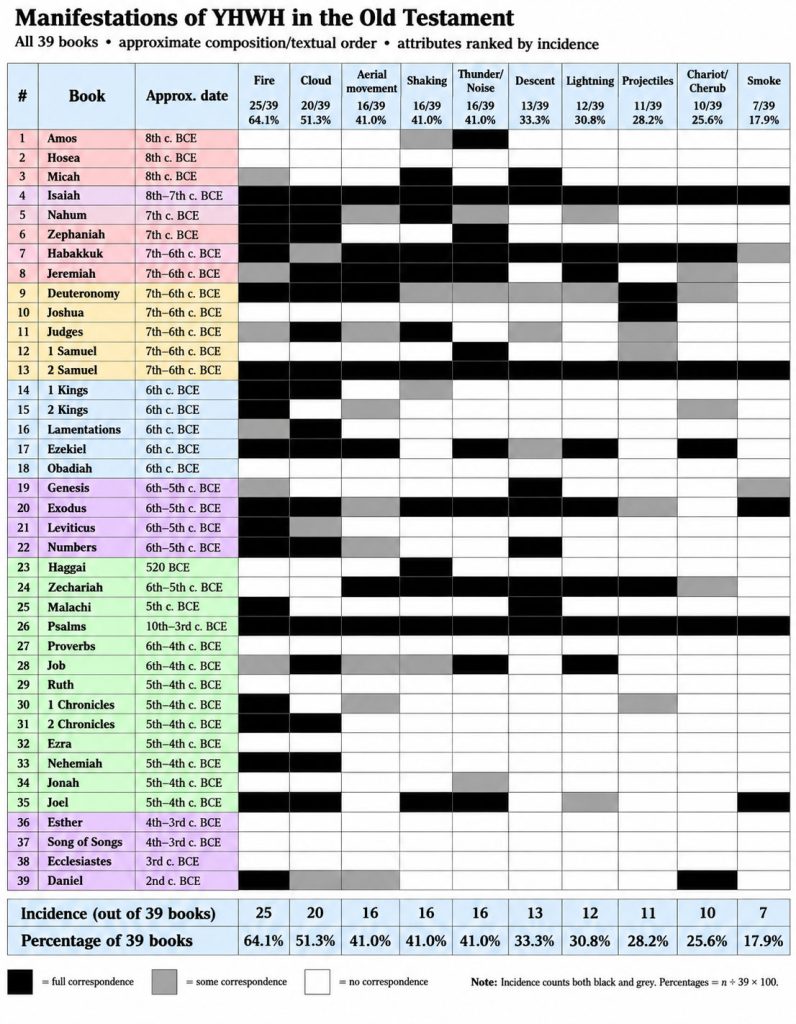
These features were then used as a reference set for examining their distribution elsewhere in the Old Testament. For each book represented in the sample, the presence of each attribute was coded in three degrees: black for a clear correspondence, grey for a partial or uncertain correspondence, and white where no correspondence was identified. Where several relevant passages occurred within the same book, the book was treated as showing the attribute if it appeared in at least one of those passages.
The books were arranged in approximate chronological order, while the attributes were arranged from highest to lowest incidence. This allowed three questions to be considered: how widely the Psalm 18 attributes are distributed across the Old Testament; whether their concentration shows any relationship to chronology; and whether some attributes are markedly more salient than others.
The method is necessarily approximate. The dates of many biblical books are disputed, some books contain material from more than one period, and the distinction between full and partial correspondence involves judgement. The table therefore identifies patterns rather than establishing precise historical sequences. These uncertainties have not always been sufficiently recognised. Treating composite texts, disputed dates and interpretative correspondences as though they provided straightforward historical evidence can encourage dogmatic conclusions which the evidence itself does not necessarily justify. Nor is any large historical claim being made here on the basis of the statistical analysis presented. It simply draws attention to a curious distribution of the features under review which may be worth examining further.
Summary of Findings
Attributes associated with manifestations of YHWH—fire, cloud, smoke, thunder or violent noise, shaking of the earth, descent, aerial movement, lightning or flashes, projectiles, and chariot or cherub imagery—are widely distributed across the Old Testament, but their incidence varies considerably. Of the 39 books examined, fire occurs in 25 (64.1%) and cloud in 20 (51.3%). Aerial movement, shaking and thunder/noise each occur in 16 (41.0%); descent in 13 (33.3%); lightning in 12 (30.8%); projectiles in 11 (28.2%); chariot/cherub imagery in 10 (25.6%); and smoke in 7 (17.9%).
When the attributes are placed in descending order of incidence, the resulting line is striking. After fire and cloud there is a marked fall to the group at 41%, followed by a further, almost step-by-step decline:
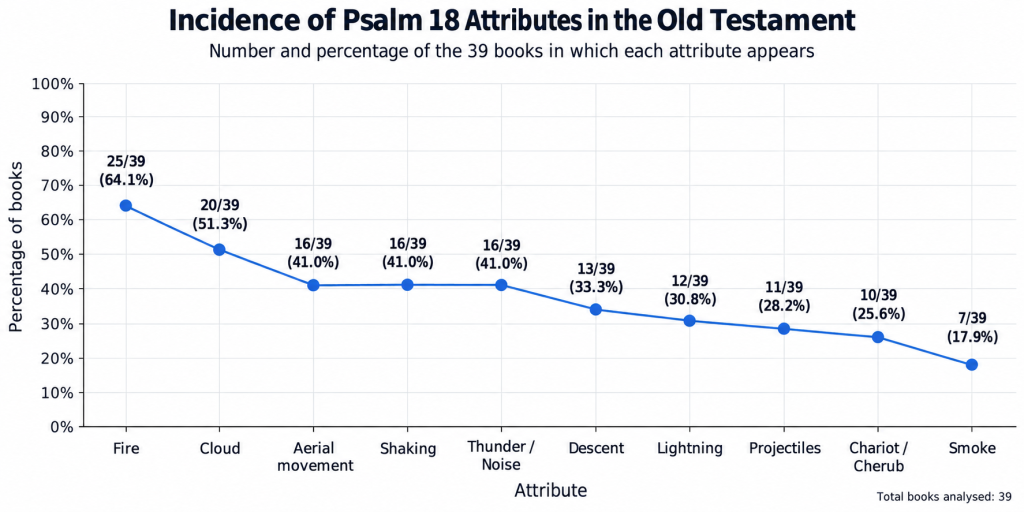
Some caution is necessary here: because the attributes have deliberately been sorted from most frequent to least frequent, a descending line is inevitable. What is significant is the shape and spacing of that decline. The figures suggest a hierarchy of salience rather than ten equally characteristic features. Fire and cloud stand out as the most widely distributed attributes; aerial movement, shaking and thunder/noise form a second tier; descent, lightning, projectiles and chariot/cherub imagery become progressively less frequent; and smoke is distinctly uncommon.
This helps to explain what is exceptional about Psalm 18/2 Samuel 22. None of its individual features is necessarily unique. What is unusual is their concentration. Features scattered unevenly throughout the rest of the Old Testament occur together here in a single, highly elaborate description. The passage therefore represents something close to a maximal expression of a much more widely distributed tradition.
The chronological table adds another dimension. The density of correspondence appears to decrease over time. Earlier and pre-exilic material contains comparatively large blocks of black and grey, whereas the later post-exilic material (after Obadiah, Row 18) and the Hellenistic texts contain substantially more white space. The change is not uniform: older imagery survives in later writings, and the dating and composition of many books remain uncertain. Nevertheless, the visual tendency is difficult to ignore. The physical and dramatic representation of YHWH appears to become less densely expressed in later literature.
There are therefore two related patterns. Across the Old Testament there is a hierarchy of YHWH attributes, ranging from relatively persistent features such as fire and cloud to much rarer ones such as smoke, chariot/cherub imagery and projectiles. Across approximate chronology there is also a decline in the concentration of the complete warrior-theophany cluster. Individual motifs survive, but fewer later books assemble substantial numbers of them together.
This chronological decline is particularly interesting when set beside another development already identified in the later biblical literature: the increasing prominence of a different conception of God, expressed less through physical manifestation and military intervention and increasingly through wisdom, universality, moral order and reflection. The two strands should not simply be equated, nor does one prove the disappearance or replacement of the other. Nevertheless, the chronological concurrence between the diminishing concentration of God the Warrior and the increasing prominence of this wider conception of God is striking and deserves further investigation.
The attributes themselves are not exclusively military. They occur in battle narratives, judgement scenes, theophanies, visions and worship texts. They appear to constitute a broader vocabulary of divine manifestation and overwhelming power, of which military intervention is one important expression. What persists across these different settings is the strongly sensory and kinetic character of the imagery: fire is seen, thunder is heard, the earth shakes, something descends or moves through the air, flashes appear and destructive force is released.
None of this establishes what such imagery originally represented. Storm phenomena, warfare, inherited mythological language, ritual imagery, remembered experience and other explanations remain possible. More unconventional interpretations have also been proposed. Mauro Biglino, in Gods of the Bible: A New Interpretation of the Bible Reveals the Oldest Secret in History (2023), argues for a strongly literal reading of many biblical descriptions, including the identity of YHWH and the meaning of elohim. Paul Wallis, in Escaping from Eden: Does Genesis Teach that the Human Race was Created by God or Engineered by ETs? (2020), similarly suggests that some biblical traditions may preserve memories of encounters subsequently understood as divine.
Such interpretations remain speculative, but they are relevant because they challenge the assumption that the imagery must automatically be reduced to theology or metaphor. The statistical analysis cannot identify the original referent, nor can it decide between competing interpretations. It establishes something more limited but important: Psalm 18 and 2 Samuel 22 preserve an exceptionally concentrated physical portrayal of YHWH whose individual features recur widely throughout the Old Testament, occur with markedly different frequencies, and collectively appear to diminish in concentration in later texts.
The strongest conclusion, therefore, is not that the evidence identifies YHWH as a storm god, dragon, vehicle or technological entity. It is that the Old Testament repeatedly represents YHWH through a recognisable group of sensory, physical and kinetic phenomena, and that this representation itself appears to have a history. Its components remain present, but their concentration declines as the literature moves towards later periods, at approximately the same time as broader and more abstract ways of conceiving God become increasingly prominent.