
How the graph is structured
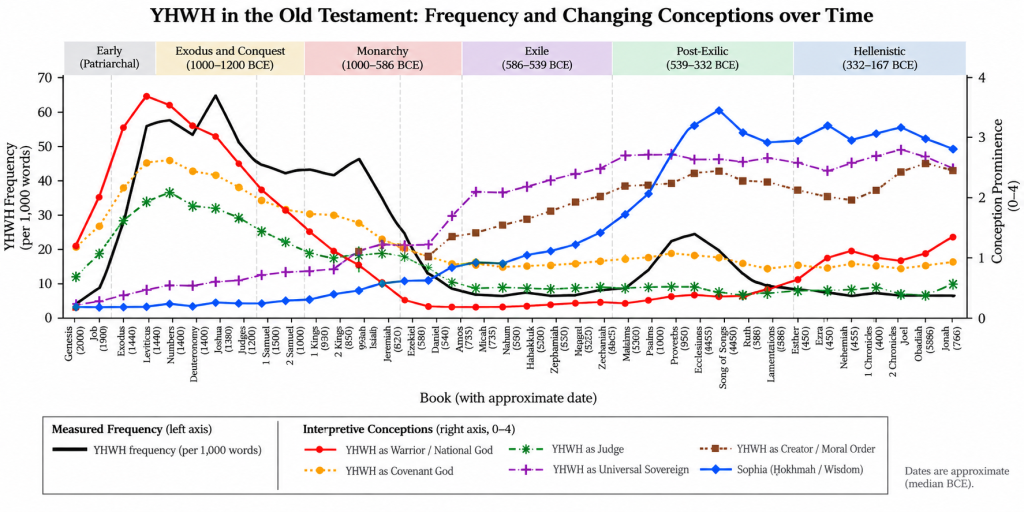
The graph places selected books of the Old Testament in their approximate chronological order of composition, rather than their order in the Bible. The dates beneath the books are necessarily approximate, since many biblical books contain material written or edited at different periods.
The black continuous line is different from all the other lines. It represents quantitative evidence: the frequency of the Hebrew name YHWH, expressed as occurrences per 1,000 Hebrew words. It therefore shows how prominent the divine name is within each text.
The coloured lines represent something different. They are interpretive classifications of the principal ways in which God is portrayed in the texts. They distinguish such conceptions as the Warrior God, Covenant God and Judge from Universal Sovereign, Creator or source of cosmic order, and Wisdom (Ḥokhmah, later Greek Sophia). These lines are based upon our reading and classification of the texts; they are not statistical measurements comparable with the YHWH count.
The most striking feature is the overall X-shaped pattern. In the earlier material, the Warrior, Covenant and Judge conceptions are particularly prominent. Across the middle period, especially around the age represented by Isaiah and Jeremiah, these tendencies intersect with conceptions of YHWH whose authority extends increasingly beyond Israel: universal sovereignty, creation and cosmic order. In later writings, Wisdom becomes increasingly important. The two broad clusters therefore appear to diverge towards the later end of the graph.
What might be inferred
The graph suggests that the conception associated with YHWH may have undergone a substantial historical development. Earlier texts frequently present YHWH in strongly national, covenantal and martial terms: Israel’s protector, judge and defender against its enemies. Later texts increasingly permit God to be conceived as sovereign over all nations, creator of the world and source of an intelligible moral and cosmic order. Wisdom provides a still less anthropomorphic vocabulary through which the relationship between humanity, creation and the divine can be expressed.
The apparent crossing of these tendencies around the period of Isaiah and Jeremiah is particularly interesting because it broadly coincides with profound changes in Israel’s historical circumstances: Assyrian domination, the destruction of the northern kingdom, the decline of Judah, Babylonian conquest and eventually exile. A conception of YHWH primarily as Israel’s victorious national protector became increasingly difficult to reconcile with historical experience. A God who ruled foreign empires and ultimately the whole created order could accommodate those experiences rather differently.
The graph may also help explain another development. The older Warrior, Covenant and Judge strand did not disappear. When immediate historical deliverance failed to occur, some of its expectations could be projected into the future: restoration, judgement, redemption and the eventual appearance of an anointed or saving figure. Alongside this, the Universal-Creator-Wisdom strand offered an increasingly transcendent understanding of God. These need not represent successive religions; they could survive simultaneously as different inheritances within later Judaism.
None of this constitutes proof of a historical evolution from one conception of God to another. The chronology is approximate, biblical texts contain material from different periods and, most importantly, the conceptual lines on the graph depend upon interpretive judgements that have not been established by an exhaustive independent analysis of every Hebrew passage.
The graph should therefore be regarded as a hypothesis-generating model. Its importance lies in the pattern it exposes and the questions that pattern raises. If a fuller study using independently defined textual criteria reproduced the same X-shaped relationship, there would then be much stronger grounds for arguing that changing historical circumstances were accompanied by a significant transformation in the way YHWH was understood.
For the present, the graph does something more modest but potentially valuable: it identifies a correlation sufficiently striking to justify further research.