Part 1. The Descent of the Holy Spirit in Acts
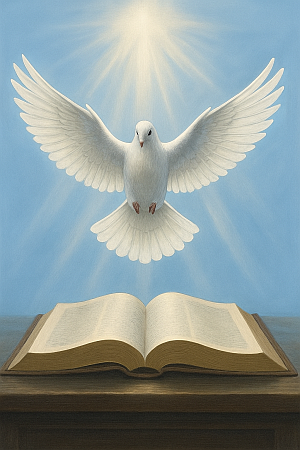
The book of Acts contains more than fifty references to the Holy Spirit, making it the most Spirit-saturated narrative in the New Testament. In the Pauline sections especially, the Spirit is not described in abstract doctrinal terms but in vivid experiences of descent, filling, and guidance. What Luke presents is not a concept but a reality of awakening: the Spirit arrives as sudden understanding, conviction, or courage.
Key examples include:
- Paul himself (Acts 9:17–18). After his encounter on the Damascus road, Ananias prays: “Brother Saul… the Lord Jesus has sent me so that you may regain your sight and be filled with the Holy Spirit.” His apostleship begins with a Spirit-inspired awakening rather than intellectual argument.
- Confrontation at Cyprus (Acts 13:9–12). Paul, “filled with the Holy Spirit,” exposes Elymas the sorcerer’s deceit. The proconsul, astonished, believes. Here the Spirit sharpens perception, enabling clarity where deception prevailed.
- Antioch in Pisidia (Acts 13:52). After Paul’s teaching, “the disciples were filled with joy and with the Holy Spirit.” The Spirit manifests not as spectacle but as communal awareness and joy.
- Ephesus (Acts 19:1–7). Paul baptises disciples who had only known John’s baptism. “The Holy Spirit came upon them, and they spoke in tongues and prophesied.” This mirrors Pentecost itself — a moment of sudden, transformative realisation.
In each case, the Spirit does not descend as a physical object. It is the name given to a shared awakening: a breakthrough of understanding, conviction, and alignment with God’s purpose. For Luke and his readers, “Holy Spirit” was the semantic token that captured this moment of revelation — a way of naming the experience of sudden awareness.
Part 2. From “Holy Spirit” to Consciousness and Awareness
Luke wrote in the language of his age. Pneuma in Greek meant “breath,” “wind,” or “spirit.” To say the pneuma hagion had “come upon” someone was to express a moment of profound awakening — when the hidden became clear and the weak became strong.
Today we reach for different semantic tokens. Our vocabulary is shaped by psychology and philosophy rather than temple ritual and prophecy. Where Luke wrote “Holy Spirit,” we might just as readily say:
- Consciousness — the awakening of mind and perception beyond the habitual.
- Awareness — an inner recognition of truth once unseen.
- Attunement — the sense of being aligned with a deeper moral or spiritual reality.
When Paul’s hearers are “filled with the Holy Spirit,” what is described is a shift of consciousness: from not knowing to knowing, from confusion to clarity, from fear to joy. To translate “Spirit” into our modern idiom is not to reduce it to psychology but to recognise that the same human experience — awakening into truth — is being named through different tokens.
For Luke, the Spirit was God’s active presence. For us, it might be framed as consciousness, awareness, or presence. Different words, same reality: a transformation of perception that alters the course of life.
Part 3. Romans 12:1 and the Balanced Life
Paul’s exhortation in Romans 12:1 brings this movement of Spirit and awareness into sharp focus:
“I urge you, brothers and sisters, by the mercies of God, to present your bodies as a living sacrifice, holy and acceptable to God — this is your true and proper worship.”
The language of sacrifice reflects the temple world Paul inherited. But the meaning is not ritual slaughter; it is whole-life dedication. The body, with all its actions and choices, is to be offered consciously, not compulsively. Worship becomes not a moment in the temple but the shape of an entire life.
Seen through the lens of Acts, this is the natural outcome of Spirit-awakened awareness. When the Holy Spirit descends — or, in our language, when consciousness is awakened — the result is not just joy or understanding but transformation of behaviour. To be “filled with the Spirit” is to be enabled to live differently: in balance, in service, and in freedom from compulsion.
This links directly to our own vocabulary of health: through understanding we discover what the body truly needs. Just as balanced nutrition sustains physical wellbeing, so Spirit-awakened awareness sustains moral and spiritual health. Both involve discernment — knowing when appetite or habit misleads us, and recognising what truly nourishes life.
Thus Romans 12:1 reframes the work of the Spirit:
- Awareness becomes action. What was once a moment of realisation becomes a sustained way of living.
- Consciousness becomes offering. Life itself is presented as worship, not in parts but as a whole.
- Attunement becomes balance. The body is neither despised nor idolised but used wisely, in harmony with mind and spirit.
What Luke in Acts called the Holy Spirit’s descent, Paul here calls the conscious offering of the self. Both point to the same reality: wakefulness lived out as devotion.