
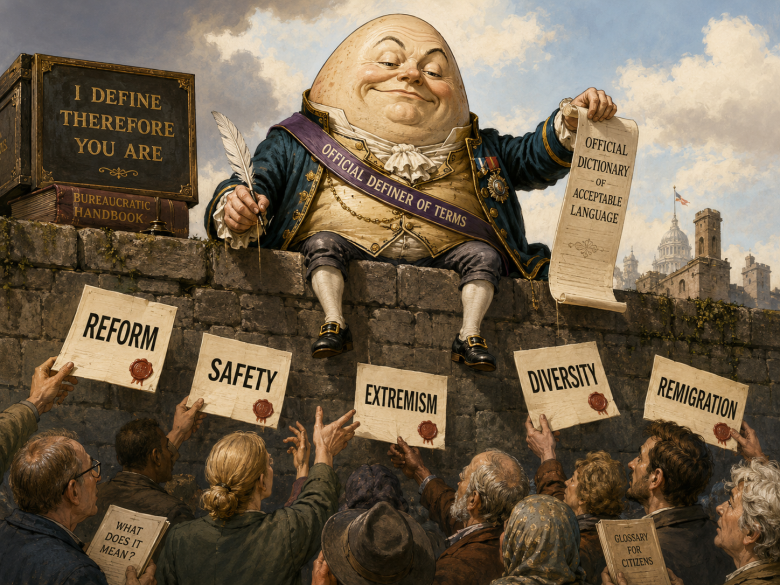
argon once obscured meaning. Today, institutional language often goes further: it defines the permitted interpretation before discussion begins. When words carry an approved moral judgement and an intended conclusion, language ceases to serve inquiry and begins to police thought.

Eine kritische Zwischenbilanz zu Gerald Grosz’ Ab nach Hause: über den unklaren Begriff der Remigration, einen überladenen Stil und die Rhetorik der Verachtung.
The *Janet and John* books are now criticised for their lack of diversity, but their more serious weakness was educational. The look-and-say method encouraged children to memorise whole words instead of learning systematically how letters represent sounds. For some baby boomers, the consequences may have lasted a lifetime.

The Nottingham maternity scandal shows how a public institution can become closed, hierarchical and resistant to criticism. The failures identified in Donna Ockenden’s review reveal the dangers that arise when authority protects itself, controls knowledge and dismisses those who challenge it.

A short reflection on the Government’s proposed under-16 social media ban, arguing that online harm to children is real, but that protection must not become the route by which family responsibility is replaced by state control and digital identity.
Britain’s decline did not begin with Suez; Suez merely exposed a deeper erosion already under way. This article examines the weakening of Britain’s imperial, financial and governing foundations, then asks whether the United States may be approaching its own equivalent moment of revealed limitation.

As the supernatural cosmology of Christianity loses its authority, its moral questions remain. This article proposes “moral economics” as a practical framework based on responsibility, reciprocity, stewardship, cost, benefit and consequence.

Britain’s immigration debate is often framed in terms of compassion, race and national identity. This article asks a more practical question: how many people can the country house, employ, support and integrate without weakening public services, increasing resentment or exceeding the limits of public consent?

A reassessment of Enoch Powell’s immigration argument in light of his academic distinction, his 1971 Dick Cavett interview, the Race Relations Act 1968, and Britain’s unresolved post-imperial citizenship problem. Powell’s case is examined as a constitutional and demographic argument, not as a simple slogan.

Kemi Badenoch speaks with confidence, but confidence is not judgement. Her support for Trump over Iran raises a wider question about modern politics: whether sharp performance and quick positioning are being mistaken for the seriousness needed to address Britain’s long-term problems.