
The recent appointment of Dame Sarah Mullally, DBE, as Archbishop of Canterbury marks a historic turning point in the Church of England. Christianity, until very recently, was a male-dominated religion. Bishops, priests, and popes were men; women served in supporting roles as nuns, teachers, or mystics but rarely as official leaders. The admission of women into the clergy in Anglicanism and some Protestant churches has been hailed by reformers as progress — and dismissed by critics as “wokism,” a capitulation to modern liberal politics rather than genuine spiritual renewal.
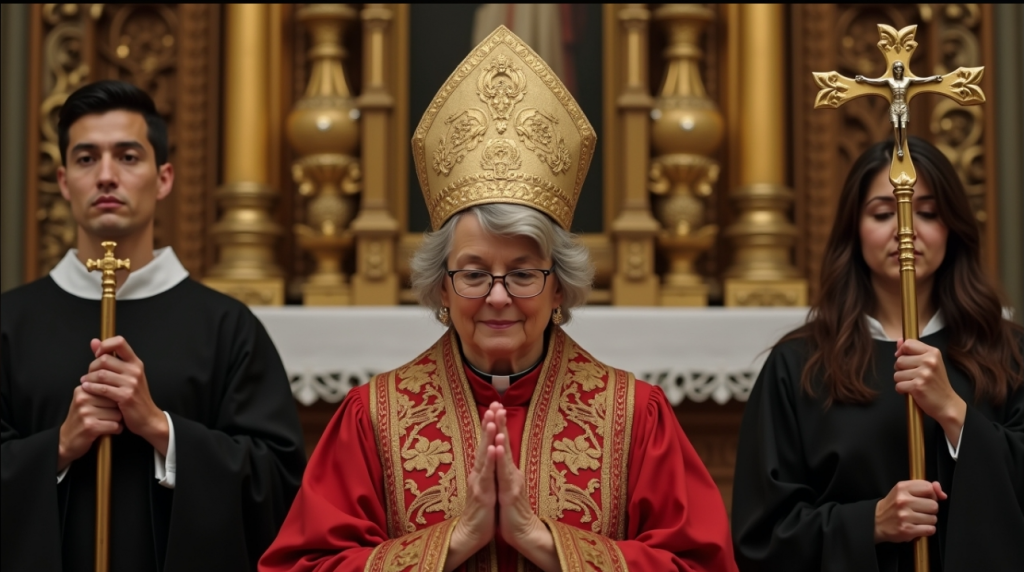
This debate raises wider questions: to what extent are all religions male-dominated? And why do men so often assume the role of spiritual leaders?
1. Male Domination Across Religions
The pattern is remarkably consistent.
- Judaism: rabbinic leadership has been overwhelmingly male until the late 20th century, when Reform and Conservative branches began ordaining women.
- Islam: women play roles in teaching and piety, but formal leadership of prayer and jurisprudence is male-dominated.
- Hinduism: priesthood is largely restricted to men, though female gurus and mystics exist and can achieve wide followings.
- Buddhism: nuns exist, but in many regions full ordination was suppressed or left subordinate to monks.
- Catholicism and Orthodoxy: the priesthood remains closed to women.
- Traditional religions: shamanic roles are more flexible; in Siberia, Africa, and the Americas, women sometimes serve as shamans or spirit-mediums, yet men usually dominate public ritual and political authority.
In short, across the world’s faiths, religious authority has tended to mirror political authority: overwhelmingly male.
2. Biology and the “Anchor” of Gender Roles
One reason is biological. Women bear and nurse children. No known society has “naturally” handed infants over to men for primary care. This fact alone meant that in early human groups, women were tied to the immediate circle of family and survival, while men were freer to hunt, raid, or form warrior bands.
Where descent was uncertain in promiscuous societies, men often invested little in offspring — or invested in sisters’ children instead, where maternity was certain. Over time, these divisions hardened into symbolic archetypes:
- Man = protector, provider, lawgiver.
- Woman = nurturer, carer, guardian of fertility.
3. The Archetype of Male Leadership
Religions everywhere coded these roles into spiritual symbols. The god as Father, King, or Warrior; the priest as judge and sacrificer; the prophet as stern law-bringer. Leadership became imagined in terms of “masculine energy” — assertive, risk-taking, even aggressive.
This was not inevitable. Matrilineal and matrifocal societies — such as the Iroquois, the Minangkabau of Indonesia, or certain African traditions — gave women real authority. Ancient priestesses (Delphi’s oracle, Rome’s Vestals) wielded sacred power. Yet the prevailing pattern remained patriarchal.
4. Women’s Achievements and the Cracks in the Order
History shows that once the structures shift, women excel in “male-coded” domains. Jane Austen, George Eliot, and Toni Morrison wrote works as profound as any male novelist. Clara Schumann and Fanny Mendelssohn composed and performed music at the highest level — and, more recently, the Austrian flautist Ulrike Anton has earned international acclaim as a performer and scholar. Queens from Elizabeth I to Catherine the Great wielded authority as effectively as kings.
In politics, though fewer in number, women leaders have shown themselves capable of war and peace alike: Thatcher in the Falklands, Golda Meir in Israel, Indira Gandhi in India. Their relative rarity has less to do with nature than with the barriers erected by culture.
5. Segregation and Comfort Zones
There is also a psychological layer. Boys and girls naturally segregate themselves in childhood play. Many adults still prefer same-sex company in friendship or professional life. This instinct for same-sex solidarity strengthens male networks of power — the proverbial “old boys’ club” — which women often find hard to penetrate.
Thus, the persistence of male leadership is not only about brute strength or tradition, but also about social comfort zones: men prefer to deal with men, reinforcing their dominance generation after generation.
6. Pascal’s Point: The Heart Has Its Reasons
Blaise Pascal famously said, “Le cœur a ses raisons que la raison ne connaît point” — the heart has its reasons, which reason does not know. Rationally, women are fully capable of leadership, and anthropological evidence shows that patriarchy is not universal. Yet deep-seated archetypes — the “heart’s reasons” — still make many people uneasy about female clergy or leaders.
It is less a question of logic than of inherited emotional patterns: man as protector, woman as nurturer. These ideas persist, however irrational, and help explain why changes in religious leadership feel “unnatural” to some.
7. Conclusion: Tradition, Change, and Renewal
While many today assume that women have no historic claim to spiritual authority, this is a conditioned response shaped by later orthodoxy rather than the full witness of early Christianity. In the first two centuries, the boundaries of church life were far more fluid. Communities gathered in private homes, where the owner of the house — often a woman — naturally assumed a position of leadership. Lydia of Philippi (Acts 16:14–15) is named as the first European convert and as the head of her household church. Priscilla, mentioned repeatedly with her husband Aquila, is described in Acts 18:26 as correcting the teaching of Apollos, an accomplished preacher. Phoebe, commended by Paul in Romans 16:1, is called a diakonos of the church at Cenchreae, the same term used of male deacons. And Junia, also in Romans 16:7, is praised as “outstanding among the apostles” — a title later generations found so uncomfortable that her name was masculinised in some manuscripts to “Junias.”
Women also played central roles in charismatic ministries. The Book of Acts notes that Philip the evangelist had four unmarried daughters who prophesied (Acts 21:9), an early reminder that the gift of prophecy — highly prized in the first church — was not restricted by gender. Outside the New Testament, movements like Montanism in the 2nd century gave equal authority to women prophets such as Priscilla and Maximilla, whose visions shaped entire communities. The fact that Church Fathers like Tertullian felt the need to rebuke women for “teaching, baptizing, and offering Eucharist” is indirect testimony that such practices were happening in some circles.
Yet even within the New Testament itself, a tension appears. The authentic Paul seems to accept and even praise women in ministry, while the so-called Pastoral Epistles (1 Timothy, Titus, and probably Ephesians) — likely written after Paul’s death by followers in his name — impose restrictions on women’s speech and leadership. The same Paul who greets Junia the apostle is later made to say, “I do not permit a woman to teach or to assume authority over a man” (1 Timothy 2:12). This contradiction reflects the church’s transition from charismatic, house-based gatherings to structured institutions anxious for public respectability. In effect, the “later Paul” curtails the freedom of the “earlier Paul.”
Over time, as Christianity grew from small, charismatic gatherings into a structured and hierarchical institution, these roles were further curtailed. The 3rd-century Didascalia Apostolorum allowed for female deacons but confined them largely to ministry with women. By the 4th and 5th centuries, with the rise of episcopal authority and the fusion of church and empire, the official priesthood was closed to women, and their earlier prominence faded from memory. Orthodoxy, in defining itself against Gnostic sects and heterodox movements where women often played larger roles, reinforced the link between authority and maleness.
To recall this history is to see that women in leadership is not a modern invention or a “woke” novelty. It is, rather, a recovery of elements present in the earliest church, long suppressed as hierarchy solidified into Roman Catholic form.
The appointment of Dame Sarah Mullally as Archbishop of Canterbury symbolizes more than personal achievement — it represents a dramatic shift in Christianity’s self-understanding. For almost two millennia, male leadership was the norm; women played vital but secondary roles. Reformers insist this change is faithful to the Gospel’s deeper spirit: “There is neither Jew nor Greek, slave nor free, male nor female, for you are all one in Christ Jesus” (Galatians 3:28).
Yet critics argue that such verses are being isolated and stretched beyond their context, while the far weightier tradition of male priesthood is being discarded in the rush to satisfy modern political ideals. The danger is that what looks like renewal may instead accelerate decline, as disillusioned believers abandon a church they see as losing its theological anchor.
The real question remains: can spiritual authority evolve without collapsing into fashion? Unless the Church can show that these reforms spring from genuine theological depth, rather than “wokism,” it risks trading sacred order for shallow symbolism — and losing its people in the process.
An honest appraisal of orthodox Christian belief, set alongside the witness of the earliest communities and recent historical discoveries — from catacomb frescoes in Rome to Nag Hammadi manuscripts in Egypt — might allow for a more balanced and theologically grounded acceptance of women’s leadership. Rather than undermining the faith, such a recovery could be seen as restoring dimensions of the Gospel that were lost when hierarchy eclipsed charisma.
By contrast, some modern religious movements, such as Jehovah’s Witnesses, openly embrace what they call “new light”—progressive revelation said to shine more brightly as “the end of this system” approaches. They base this on Proverbs 4:18: “The path of the righteous is like the morning sun, shining ever brighter till the full light of day.” In practice, this “light” is defined by the Governing Body, whose reinterpretations of doctrine are presented as divinely guided clarification. Ironically, such “new light” never comes from archaeology or discoveries like the Nag Hammadi manuscripts that show women in leadership roles; it is confined strictly to reinterpretation of their own canon. Mainline churches, however, tend to move in the opposite direction: they resist doctrinal revision in the name of continuity, even when historical evidence suggests the earliest Christian practice was more diverse than later orthodoxy admitted.
Perhaps the hardest truth to face is that we do not know where a valid reinterpretation of Christianity might arise today. The great institutions of faith seem caught in contradiction: the orthodox churches cling so tightly to tradition that they risk fossilisation; the liberal churches chase relevance so quickly that they risk thinning the Gospel into cultural fashion. Sectarian movements like Jehovah’s Witnesses embrace change under the banner of “new light” but confine it to authoritarian reinterpretation within their own canon.
If history teaches anything, it is that renewal seldom begins at the centre. The early church itself was born in houses, catacombs, and margins, not in temples or palaces. When Christianity has rediscovered its soul, it has usually done so through forgotten texts, silenced voices, and small communities daring to live the Gospel with authenticity. Perhaps the hope of a lost and desperate generation will not come from councils, synods, or papal decrees, but from such margins once again — from ordinary believers who insist that truth, love, and justice can be lived even when institutions falter.