
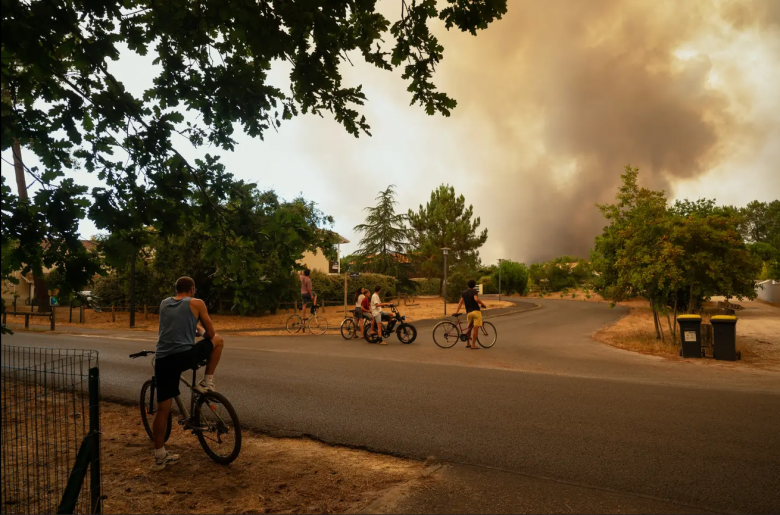

Bordeaux and the surrounding Gironde have experienced an extraordinary reversal during the first seven months of 2026: from prolonged, record-breaking rain and severe flooding in February to drought, exceptional heat and immense forest fires in July.
Winter: rain without respite
A succession of Atlantic low-pressure systems brought western France weeks of almost continuous rain. By 20 February, the region had endured 35 consecutive rainy days—the longest such sequence recorded by Météo-France since observations began in 1959. The ground became saturated, rivers could absorb no more water, and further rainfall passed directly into streams and flood plains. (European Space Agency)
The Garonne and its tributaries rose across the Gironde. La Réole, Langon and Cadillac-sur-Garonne were among the worst-affected places, while the Bordeaux quays, riverside roads and low-lying districts were inundated. On 19 February, the Garonne reportedly reached 5.04 metres at Bordeaux. (Copernicus Emergency Management Service)
The flooding was not confined to Bordeaux. Across western France, thousands lost power, transport was disrupted and nearly 2,000 people were evacuated. At the height of the emergency, flood warnings covered an exceptionally large part of the country. (euronews)
Spring and early summer: the rapid drying-out
The remarkable feature of 2026 was not merely that a wet winter was followed by a dry summer; that is normal to some extent in south-western France. It was the speed and severity of the change.
After the winter saturation, prolonged warmth and lack of useful rainfall began drawing moisture from the upper soil. High temperatures accelerated evaporation from the ground and transpiration from vegetation. Forest litter, heathland and the vast pine plantations west of Bordeaux progressively became combustible.
By July, drought rather than flooding had become the chief concern even for the Bordeaux wine industry. The vineyards themselves had not been reached by the major fires as of 27 July, but growers were increasingly worried about the shortage of water. (Reuters)
July: the Gironde burns
On 22 July, a forest fire began near Saumos, west of Bordeaux. Driven by extreme heat, dry vegetation and changing winds, it expanded with exceptional speed through the pine forests towards the metropolitan area.
By the afternoon of 27 July, the Gironde prefecture estimated that approximately 42,000 hectares had burned. Around 220,000 residents and holidaymakers had been evacuated since the fire began. These are far greater figures than those associated with the Gironde fires of 2022. (Gironde)
At different stages the flames approached Bordeaux to within roughly 15 kilometres. Evacuations affected communities on the western side of the conurbation, while Bordeaux’s exhibition centre was used to receive displaced people. Thousands of firefighters, soldiers, police officers and aircraft were mobilised. (Reuters)
The fire became so intense that it generated a pyrocumulonimbus cloud—a fire-created thunderstorm capable of producing violent winds and lightning that can start further fires. According to reports, this was the first recorded occurrence of such a phenomenon in France. More than 240 homes were destroyed or damaged. (AP News)
Two extremes, one increasingly unstable climate
It would be simplistic to say that February’s floodwater somehow “caused” July’s fires. The processes were different: persistent Atlantic rainfall produced the flooding, whereas heat, drought, dry vegetation and ignition produced the fires.
Nevertheless, the violent transition illustrates an important feature of climate change. A warmer atmosphere can hold more moisture and intensify episodes of heavy rain; higher temperatures also increase evaporation, dry soils and vegetation more rapidly, and make severe fire weather more likely. Climate change does not abolish Bordeaux’s seasons—it loads them with greater extremes.
In February, Bordeaux had more water than its rivers and soil could contain. Five months later, the same region had become dry enough to sustain a fire covering 420 square kilometres.
Bordeaux in 2026 has therefore moved, almost literally, out of the swimming pool and into the fire.
Spain has followed much the same 2026 pattern as south-western France: an exceptionally wet winter and spring, followed by abrupt drying, repeated heatwaves and catastrophic fires.
In January and February, Atlantic storms brought torrential rain, snow and damaging winds across large parts of Spain. Southern and western regions were particularly badly affected. Flooding around Grazalema and elsewhere in Andalusia followed prolonged rainfall on already saturated ground, with evacuations, blocked roads and widespread disruption. (ReliefWeb)
The heavy rain also encouraged abundant growth of grasses and other vegetation. When rainfall diminished and temperatures rose, this new growth dried rapidly. It then formed an unusually large quantity of fine, highly combustible fuel. This same progression—from luxuriant wet-season growth to tinder-dry summer vegetation—has contributed to the severity of fires in both France and Spain. (The Guardian)
By June, Spain had entered its first official heatwave of the year. Further heatwaves followed in July, with temperatures reaching or approaching 45°C in parts of the country. By 27 July, AEMET was forecasting a fourth heatwave, while rainfall remained scarce and fire danger across much of mainland Spain was rated very high or extreme. (euronews)
The resulting fires have been unprecedented in extent and destructiveness. Major outbreaks have affected Andalusia, Ávila, Madrid, Toledo, Zaragoza, Guadalajara and other regions. A particularly deadly fire in Almería killed 13 people, while enormous fires west of Madrid and in Ávila forced mass evacuations. By late July, more than 150,000 hectares had burned since the beginning of the year—about six times the area burned by the same stage of 2025. (Reuters)
The resemblance to Bordeaux is therefore striking:
Winter: storms, saturated ground and floods.
Spring: vigorous vegetation growth.
Early summer: rapid drying and drought.
July: repeated extreme heat, strong winds and uncontrollable fires.
The wet winter did not prevent the fires. In one respect, it helped prepare them by producing vegetation that later became fuel. Spain, like Bordeaux and the Gironde, has gone out of the swimming pool and into the fire—but over a much larger geographical area.