
Luke 22:19
1. The disappearance of Jesus behind Christianity
The historical preacher is almost inaccessible. Between Jesus and the reader stand oral transmission, evangelists writing theological narratives, Greek translation, Pauline interpretation, Church councils and centuries of doctrine. Christianity claims absolute certainty about a man whose actual words and intentions remain largely unrecoverable.
2. Why did Jesus leave nothing in writing?
For a revelation intended for all humanity, this is an extraordinary omission. Jesus wrote no book, authorised no definitive account and established no reliable method of preserving his teaching. The result was immediate dependence upon memory, interpretation and institutional authority.
3. The absent God
Christianity presents God as urgently concerned with humanity while explaining his continued silence and invisibility. Why should a loving God make the truth about salvation dependent upon disputed ancient texts, cultural inheritance and uncertain interpretation?
4. Faith as a remedy for insufficient evidence
Christianity often turns evidential weakness into a spiritual virtue. Doubt becomes a failure of faith; belief without adequate evidence becomes praiseworthy. You could examine how this protects the religion against the ordinary standards by which other claims are judged.
5. The invention of orthodoxy
Early Christianity was not a single, settled faith. Competing groups held different views of Jesus, resurrection, salvation, scripture and God. “Christianity” emerged partly through the victory of certain factions, followed by the classification of rivals as heretics.
6. The canon as a human selection
Why are these books Scripture and others not? The New Testament did not descend as a completed volume. Communities selected, disputed and excluded texts over centuries. Yet the eventual collection is treated as though its boundaries were divinely self-evident.
7. The strange centrality of belief
Christianity frequently makes correct belief more important than character. A compassionate unbeliever may be condemned, while a morally compromised believer may be saved through faith and repentance. This raises the question of whether Christianity is ultimately ethical or doctrinal.
8. Infinite punishment for finite error
Hell deserves separate treatment. Eternal punishment for disbelief, ignorance or wrongdoing committed during a brief human life appears grotesquely disproportionate. It also conflicts with the claim that God is just, loving and merciful.
9. Heaven and the destruction of personality
Would eternal life preserve the individual or abolish him? A person incapable of grief over the damned, boredom, dissent, change or loss might no longer be recognisably human. Heaven may require not the fulfilment of personality but its alteration beyond recognition.
10. The moral problem of substitutionary sacrifice
Punishing the innocent instead of the guilty would ordinarily be considered unjust. Christianity makes it the centre of salvation. The crucifixion can therefore be examined not merely as implausible theology but as a morally troubling conception of justice.
11. Why must God satisfy rules he created?
God supposedly requires atonement before forgiving humanity. But who established that requirement? If God did, the sacrifice solves a problem of his own making. If he did not, then God is subject to a moral or cosmic law greater than himself.
12. The failure of the Second Coming
The earliest Christians appear to have expected an imminent culmination of history. That expectation was repeatedly deferred and reinterpreted. Christianity survived not because the prediction was fulfilled, but because failure could be converted into further theology.
13. Christianity and fear
Fear of death, judgement, hell, exclusion and meaninglessness has been one of Christianity’s strongest instruments. An article could ask whether the faith offered consolation for fears it had itself intensified.
14. The sanctification of suffering
Christianity gives suffering meaning through the Cross, martyrdom, sacrifice and spiritual purification. This may comfort sufferers, but it can also romanticise pain, encourage endurance of injustice and discourage attempts to change intolerable conditions.
15. The Christian distrust of the body
Sexual desire, bodily pleasure and even ordinary human appetites have often been treated with suspicion. You could trace the tension between belief in a creator of the body and a tradition repeatedly embarrassed by bodily existence.
16. Women and the masculine divine order
God is Father, Christ is Son, the apostles are male and institutional authority has historically been male. Christianity may proclaim spiritual equality while embedding women within a symbolic and organisational structure created largely by men.
17. The religion of love and its history of coercion
The contrast between “love your enemies” and persecution, forced conversion, religious war, censorship and punishment for heresy is immense. The interesting question is not merely whether Christians failed to live up to Christianity, but whether claims to exclusive truth helped produce coercion.
18. Christianity’s dependence upon what it displaced
Christianity condemned pagan religion while absorbing pagan philosophy, festivals, imagery, sacred sites and ritual forms. It presented itself as a radical revelation while succeeding partly because it incorporated the religious habits already present in the cultures it conquered.
19. The problem of prayer
If God already knows what is needed and acts according to perfect wisdom, what can petitionary prayer change? If prayer changes God’s decision, was the original decision imperfect? If it changes nothing, prayer appears psychologically useful but causally empty.
20. Christianity as an accident of geography
Most people inherit religion from family and place. A child born in medieval England was likely Christian; one born elsewhere might be Muslim, Hindu or Buddhist. Yet eternal destiny is often made dependent upon beliefs distributed largely by historical accident.
21. The ethics of divine command
Is something good because God commands it, or does God command it because it is good? The first makes morality arbitrary; the second implies that goodness exists independently of God. This ancient dilemma strikes at the claim that God is the necessary foundation of morality.
22. The Holy Spirit and the persistence of disagreement
Christians claim guidance by the Holy Spirit yet disagree over baptism, salvation, sexuality, ministry, Scripture, sacraments, predestination and the nature of the Church. Either the guidance is remarkably unclear or human interpretation remains the actual authority.
23. The elevation of credulity into humility
Religious submission is often praised as humility, while intellectual resistance is condemned as pride. Yet accepting enormous claims on insufficient evidence may not be humility at all. It may be the surrender of judgement.
24. Christianity after the removal of the supernatural
What remains if one removes the Virgin Birth, miracles, bodily resurrection, divine atonement, heaven, hell and the Second Coming? Perhaps a moral teacher, a body of stories and a cultural inheritance—but no longer Christianity in its traditional sense.
25. Did Christianity preserve Jesus—or bury him?
The Church preserved the name and story of Jesus, but surrounded him with metaphysics, miracle, sacrifice, empire, doctrine and institutional power. The religion that ensured his immortality may also have made him impossible to see.Christianity is not merely an implausible story that people happened to believe. It is the visible surface of something much deeper.
Beneath its doctrines lie ancient patterns: the divine child, the dying and returning god, sacrificial blood, sacred meals, purification, judgement, rebirth and the final restoration of the world. Christianity did not invent these themes. They were already present in religion, mythology and folk memory.
Its remarkable achievement was to draw them together around the figure of Jesus and present them as a single historical drama. A Jewish preacher became the fulfilment of prophecy, the divine Logos, the sacrificial victim, the conqueror of death and the future judge of humanity. Paul, the evangelists and the early Church did not merely preserve a life. They transformed it into a cosmic story.
That is why Christianity cannot be dismissed simply as foolishness or fraud. Its doctrines may be historically doubtful and logically incoherent, but they speak through symbols deeply rooted in human consciousness. People did not believe only because priests deceived them or because they lacked intelligence. They recognised patterns that already carried meaning: guilt and forgiveness, death and renewal, disorder and restoration, separation and reunion.
The more interesting question is therefore not merely how people could believe such a story, but what was already present in the human mind that allowed it to acquire such extraordinary power.
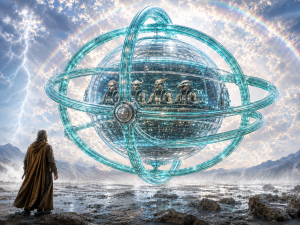
Yet there may be more involved than archetype alone. Some argue that religion and mythology preserve the distorted memory of humanity’s contact with something greater than itself. Such contact, if it occurred, may reach back tens or even hundreds of thousands of years, surviving through myth, ritual and inherited symbolism long after the original events had been forgotten.
On this interpretation, recurring stories of beings descending from the heavens, divine teachers, extraordinary births, forbidden knowledge, catastrophic destruction, battles among superhuman powers, journeys to other worlds, death and return, judgement and cosmic renewal may be more than inventions of the unconscious. They may be fragmentary cultural memories, repeatedly reshaped until any historical core became inseparable from mythology.
The hypothesis applies not only to Christianity, but to Hindu traditions, ancient Mediterranean religion, Indigenous mythologies and innumerable folk stories. Hinduism is particularly striking in its vast cycles of creation and destruction, gods appearing in human and animal form, flying vehicles, divine weapons and conflicts conducted on a cosmic scale. Similar motifs appear in Greek, Mesopotamian, Egyptian and Norse traditions and among peoples separated by great distances.
Christianity would then be only one comparatively recent expression of a much older inheritance. The incarnation, the divine messenger, miraculous power, sacrificial death, resurrection, judgement and the making of a new world might all be Christian versions of patterns already circulating for millennia.
There is no firm evidence from which an original encounter can be reconstructed as history. The recurrence of these themes nevertheless raises a legitimate question. Are they products of similar human minds confronting the same mysteries, or distorted memories of something once experienced and no longer understood?
The two explanations need not be mutually exclusive. Something extraordinary may have been encountered, while the human mind supplied the forms through which it was remembered.
Christianity must also be separated from the unknown man upon whom it was built. We do not know who Jesus really was. We do not know precisely what he said, how he understood himself, whether he intended to found a new religion, or how much was added after his death. He left no writings, and no surviving contemporary observer recorded his life.
The Jesus whom history may dimly reveal—a Jewish preacher, healer, prophet, reformer or political and religious dissident—is not identical with the Christ of doctrine. The latter is a theological construction: the pre-existent Son of God, divine Logos, sacrificial victim, conqueror of death and future judge of the world.
Between the unknown man and the doctrinal Christ lies the process by which memory became story, story became scripture and scripture became authority. Christianity is not direct access to Jesus. It is an immense interpretation of him.
That interpretation was then appropriated and reshaped by the Church. Yet institutional distortion does not prove that the inheritance contains no deeper truth. We may reject the authority of the Church, its dogmas and its claims to exclusive possession of truth without dismissing the mysteries around which Christianity was formed.
Guilt and forgiveness, sacrifice and renewal, death and resurrection, estrangement and reconciliation, innocent suffering and the hope of transformation are not confined to Christianity. They belong to the wider religious and mythological inheritance of humanity. Christianity gave them one particular form, attached them to Jesus and declared that form final.
The Church may have failed to explain these mysteries adequately, but it did not make them disappear. The historical claims may be doubtful and the doctrines incoherent, yet the realities to which they point remain.
Christianity may not provide the answer. It nevertheless preserves questions that cannot simply be ignored.