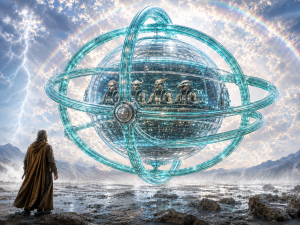
The attempt to read the New Testament as history has occupied scholars, believers, and sceptics for centuries. From the moment the printing press placed the Bible into ordinary hands, the question has been asked again and again: What really happened? The search often becomes obsessive, because the stakes are not merely academic. To discard the message of the Bible is to risk being cast into “outer darkness,” as Jesus himself put it. To accept it uncritically is to surrender reason to myth.
1. The Four Gospels
Authorship and dating
None of the Gospels name their authors. Later church tradition ascribed them to Matthew, Mark, Luke, and John. Modern scholars date Mark around AD 65–70, Matthew and Luke in the 80s, and John in the 90s or later. These are not eyewitness diaries but theological reflections written decades after the events.
Contradictions and harmonisation
Because the Gospels were written for different audiences, they diverge on crucial details:
- The cleansing of the temple:
- Mark places it at the end of Jesus’ ministry: “And they come to Jerusalem: and Jesus went into the temple, and began to cast out them that sold and bought in the temple, and overthrew the tables of the moneychangers, and the seats of them that sold doves” (Mark 11:15, KJV).
- John moves it to the beginning: “And the Jews’ passover was at hand, and Jesus went up to Jerusalem, And found in the temple those that sold oxen and sheep and doves… and when he had made a scourge of small cords, he drove them all out” (John 2:13–15, KJV).
- The genealogies:
- Matthew traces Jesus’ line through Solomon: “And Jesse begat David the king; and David the king begat Solomon of her that had been the wife of Urias” (Matthew 1:6, KJV).
- Luke traces it through Nathan: “Which was the son of Melea, which was the son of Menan, which was the son of Mattatha, which was the son of Nathan, which was the son of David” (Luke 3:31, KJV).
These can be explained theologically, but historically they cannot both be “true” in the same sense.
Theological portraiture
Each evangelist selects and shapes material. Matthew stresses fulfilment of prophecy, Luke stresses universal salvation, John presents Jesus as eternal Word. They are not neutral reporters but interpreters.
2. Acts of the Apostles
Acts reads like a seamless story of triumph, but when compared with Paul’s letters the difficulties multiply.
Literary speeches
Acts is full of speeches that could hardly be verbatim. For instance, Peter’s Pentecost sermon (Acts 2:14–36) runs to 23 verses. Ancient historians, like Thucydides, often invented speeches to summarise what “must have been said.” Luke is probably doing the same.
Discrepancies with Paul’s letters
Acts 15 portrays the Jerusalem council as harmonious: Peter speaks, James agrees, unity prevails. But Paul gives a very different picture in Galatians:
Here we see bitter conflict, not harmony. Acts smooths over the cracks to create a story of orderly growth.
Miracles and angels
Acts brims with wonders: prison doors opening (Acts 12:7–10), tongues of fire (Acts 2:3), angelic visions. To take these as literal history is difficult; to dismiss them entirely ignores their function as theological narrative.
3. Paul’s Letters
Paul’s letters are our earliest Christian writings, some within 20 years of Jesus’ death. Yet they pose their own problems.
Authenticity
Thirteen are attributed to Paul; most scholars accept seven as genuine (Romans, 1 & 2 Corinthians, Galatians, Philippians, 1 Thessalonians, Philemon). The Pastorals (1 & 2 Timothy, Titus) and Ephesians are widely seen as later forgeries.
Occasional character
Paul is not writing systematic theology. He writes into quarrels and crises. His letters are full of sharpness:
“O foolish Galatians, who hath bewitched you, that ye should not obey the truth?” (Galatians 3:1, KJV).
Divergence from Jesus’ teaching
Paul rarely quotes Jesus’ sayings. Instead, he develops a theology centred on the cross and resurrection:
“For I determined not to know any thing among you, save Jesus Christ, and him crucified” (1 Corinthians 2:2, KJV).
Compare this to the Synoptic emphasis on the coming kingdom and ethical reform. Already we see a widening gap.
4. The Psychological Dimension
The texts themselves provoke existential fear. Take the Virgin Birth:
This miracle reassures believers of divine intervention. But biologically, how could it occur? To insist on supernatural insemination collapses God into a physical agent in time and space — precisely the kind of God rulers can harness for social control. Yet to deny it risks the terror of unbelief:
This image haunts the imagination. It is the psychic architecture of religion: reason wrestles with fear.
5. Alternative Explanations
Some, like Mauro Biglino, suggest the Bible records encounters with beings from other dimensions. Angels and “sons of God” might not be metaphors but entities. Implausible? Perhaps. But as Sherlock Holmes is made to say:
The Bottom Line
The historical study of the New Testament is difficult not only because the sources are late, biased, and contradictory, but because the reader is caught in a dilemma: to accept myth is to abandon reason, but to reject it is to confront the abyss. That is why this study has been pursued with such obsessive urgency since the dawn of print. It is not merely about history. It is about meaning, fear, and the limits of faith.
Beyond the Impasse
If history cannot deliver certainty, and dogma crushes reason, then what remains? The mystics pointed toward another path. The Cloud of Unknowing counsels that God is known not by grasping but by surrender: “For He may well be loved, but He may not be thought.” Meister Eckhart speaks of a God who is born in the soul when all images are set aside. Rowan Williams echoes the same insight: faith is not the possession of answers but the cultivation of attention, a living openness to what exceeds us.
In this sense, the way out of the dilemma is not to resolve it but to step beyond it. To admit that the Gospels, Acts, and Paul cannot be harmonised into neat history, nor reduced to binding law, is not to abandon them. It is to read them as witnesses that point beyond themselves — to the silence, the unknowing, and the transformative possibility of love.