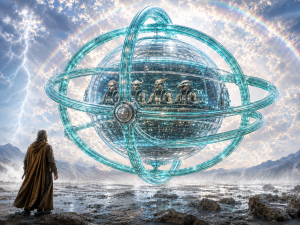
Don Cupitt’s seminal book Taking Leave of God explores ideas close to my own, though we do not arrive at exactly the same conclusions. He asked what could remain of Christianity once belief in an external, supernatural God had become intellectually untenable.
Born in Lancashire in 1934, he studied natural sciences and theology at Cambridge and was ordained as an Anglican priest. He later became Dean and Fellow of Emmanuel College and taught philosophy of religion. His best-known works included Taking Leave of God and the BBC television series The Sea of Faith.
Cupitt came to describe himself as a Christian non-realist. God, in his view, was not an independently existing supernatural being who ruled the universe from outside it. Religious language was a human creation: a way of expressing values, experiences and ways of living.
He nevertheless remained attached to Christianity for much of his life. He stopped officiating at public worship in the early 1990s, retired from university teaching in 1996 and eventually ceased to be a communicant member of the Church of England.
That long withdrawal interests me. It suggests a widening gap between the language of the Church and what he could honestly believe. He continued to dismantle doctrines that no longer survived intellectual scrutiny while trying to retain the moral, emotional and imaginative value of religion.
In this Philosophy Bites interview, Cupitt explains his non-realist understanding of God.
There is something admirable in this refusal to abandon either reason or the religious dimension of life. Yet I wonder why the process took so long.
Christianity rests upon a central historical claim: that Jesus rose physically from the dead. The later Gospel of John also tells how Jesus restored Lazarus to life—a story absent from the earlier Gospels and one which prepares the reader to accept resurrection as possible. But one miraculous narrative cannot provide evidence for another.
Some have suggested that Jesus survived crucifixion, recovered and travelled east, eventually reaching Kashmir. This replaces resurrection with an almost equally improbable escape. Crucifixion was intended to kill. Unless the Romans used rubber nails, survival followed by recovery and a journey across Asia hardly offers the more credible explanation.
Resurrection may remain powerful as a symbol of renewal, hope and the triumph of life over despair. But a symbol is different from a demonstrable historical event. Christianity’s central error was to reify an inward and imaginative truth into a supernatural occurrence that believers were required to accept as fact.
Cupitt appears to have recognised much of this, although he continued to search for a form of Christianity capable of surviving the loss of its metaphysics. The Canadian theologian Tom Harpur attempted something similar. In The Pagan Christ, Harpur treated the Gospel story largely as spiritual mythology and located the Christ principle within human beings. His historical claims about Christianity’s pagan and Egyptian origins have been strongly disputed, but his underlying intention was clear: to recover inward meaning from stories that could no longer be accepted literally.
My own journey has been different.
I waded in a sea of doubt until very recently, when I reached the shore.
My own position requires a distinction between two understandings of God.
The earlier books of the Old Testament may preserve the history of an encounter with a supreme being—or perhaps with beings (Elohim) whom ancient people understood in that way. I do not claim to know what occurred. But the narratives are sufficiently strange and persistent for me not to dismiss the possibility altogether.
Whatever that ancient presence may have been, we no longer have observable contact with it. God knows where he is now.
We therefore appear to be alone in making sense of our existence. We cannot wait for commands from heaven or expect supernatural intervention to rescue us from the consequences of our actions.
Yet another God remains: the God of conscience and consciousness.
Everything we perceive is interpreted through experience. Within us arise wonder, gratitude, moral awareness, imagination and the desire to give meaning to life. This inward God is personal. It is formed within consciousness and expressed through the human capacity for attachment, empathy, reciprocity and distress at another’s suffering—what I have called the innate goodness device.
The ethical value that Cupitt wished to preserve may therefore have a natural human source.
In general, people show a tendency to care for one another, cooperate and avoid causing unnecessary harm. Ordinary society could not exist otherwise. This disposition is neither perfect nor universal. It may be weakened by fear, cruelty, neglect, ambition and the division of humanity into competing groups.
Religion can enlarge it by extending sympathy towards the stranger and enemy. It can also restrict it by dividing people into believers and unbelievers, saved and damned, pure and impure.
The two Gods should not be confused. One belongs to the unresolved mystery of ancient history. Yes. That is where my position meets existentialism.
Once the external God is absent or silent, meaning and moral responsibility cannot simply be received from outside. Human beings must interpret experience, choose their values and accept responsibility for what they make of existence.
The other belongs to present human experience. Here religion meets existentialism: we are left to create meaning, exercise conscience and take responsibility for the world we make.
Cupitt took leave of the external God while trying to preserve religion. I have reached a different shore. I leave open the possibility that humanity once encountered something beyond itself. But whatever happened then, we have no dependable access to that being now.
The responsibility has passed to us.
The God who can still guide us is the God within: conscience brought into consciousness, tested against experience and directed towards the common good.