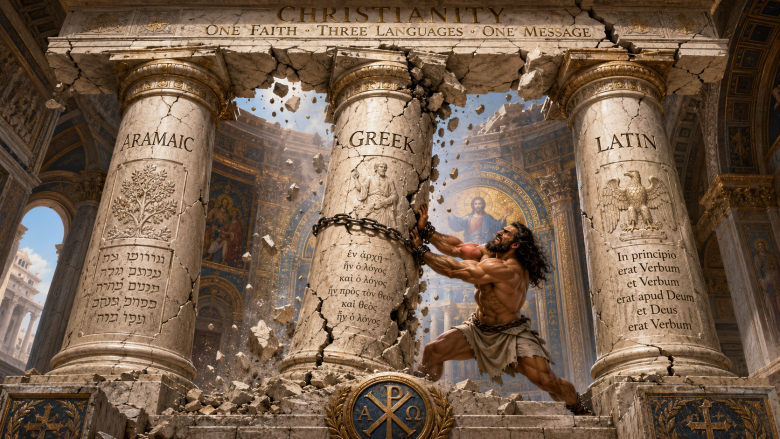
The development of Christianity can be traced through three principal languages, each representing a different cultural and intellectual world and each helping to shape the religion it transmitted.
Aramaic was the language of the original teaching. Jesus probably taught chiefly in the everyday Aramaic of Galilee, although he would also have encountered Hebrew and may have known some Greek. His sayings belonged initially to a Jewish oral world, expressed through memorable images, parables, aphorisms and patterns of speech rooted in Hebrew scripture.
Greek was the language in which the emerging belief was formulated. Koine Greek was the common language of the eastern Mediterranean and therefore the natural medium through which the movement could pass beyond its Jewish and Aramaic beginnings. Paul’s surviving letters were written in Greek, and Greek was probably his usual language of communication with the Jewish and Gentile communities he addressed throughout the eastern Mediterranean. His letters, the earliest surviving Christian documents, interpreted the life, death and significance of Jesus for those communities and helped establish much of the developing faith’s theological language.
The writings that came to form the New Testament were likewise composed in Greek. Jesus’ remembered sayings were therefore not merely recorded but translated and interpreted. Greek enabled the movement to spread beyond Palestine, while terms such as logos—word, reason or divine principle; pneuma—spirit or breath; sōtēria—salvation or deliverance; charis—grace or favour; and pistis—faith, trust or faithfulness—acquired distinctively Christian meanings through which the remembered Jewish teacher came to be understood as an increasingly theological and universal figure.
Between the walking, talking man of Galilee and the Christ of developed theology, a profound transformation took place. The remembered Jewish teacher was translated, interpreted and enlarged into a universal figure: the divine Logos, saviour of humanity, conqueror of death and centre of cosmic history.
Latin gradually became the principal language of Western institutional Christianity between the third and fourth centuries. Although the early Church at Rome had largely used Greek, Latin first acquired a substantial Christian literature in North Africa and, by the end of the fourth century, had become the dominant language of Western worship, administration and theology. Constantine and Licinius granted Christians legal toleration in 313, after which imperial patronage steadily increased. Under Theodosius I, Nicene Christianity acquired official imperial status towards the century’s end.
As the Western Church developed, Greek theology was translated into Latin. Terms such as substantia—substance, persona—person, natura—nature, gratia—grace, and sacramentum—sacrament or sacred pledge—helped give increasingly precise expression to ideas that had previously remained more fluid. In Latin hands, theology became more readily organised through definition, distinction, law and institutional formula.
Once Christianity received imperial recognition and began to assume the character of a state religion, it could no longer afford to remain a loose collection of competing beliefs. The Roman Empire was already beset by political division, civil conflict and external pressure; an imperially supported Church could not be permitted to become yet another source of disorder. If Christianity was to help sustain the unity of the empire, it first had to establish its own. Creeds were formulated, doctrines defined and rival interpretations condemned: united it might stand; divided, it could only add to the disarray around it.
Greek East and Latin West: One Faith, Two Traditions
Latin became the language of the Western Church, while Greek remained the principal language of Christianity in the Greek-speaking empire centred on Constantinople. This raises an important question: did the two linguistic worlds come to believe different things?
In their central doctrines, they did not. Roman Catholicism and Eastern Orthodoxy share the doctrinal foundation established while the Church was still formally united. Both inherited the same scriptures, creeds and decisions of the early ecumenical councils concerning the Trinity, the incarnation, the divinity and humanity of Christ, the resurrection, baptism and the Eucharist.Yet the common faith was increasingly developed within two different linguistic and intellectual worlds. In the Greek East, thinkers such as Athanasius, Basil of Caesarea, Gregory of Nazianzus, Gregory of Nyssa and, later, Maximus the Confessor shaped a spirituality centred on divine mystery, participation in the life of God, the healing and transformation of human nature, and Christ’s victory over death. In the Latin West, Augustine exercised an influence of altogether greater concentration. His treatment of original sin, inherited guilt, grace, free will, predestination and salvation established the framework within which Western Christianity—Catholic and Protestant alike—has continued to think down to the present age. The underlying doctrines remained substantially common, but the East developed chiefly through a succession of Greek theologians, whereas the West came to bear the unmistakable imprint of one commanding Latin mind.
That influence has persisted even as the institutional authority of Christianity has declined. The intensity varies considerably from country to country, but much of modern Europe has largely abandoned orthodox Christian observance. Churches have emptied, traditional doctrines have lost their hold, and Christian identity has often become cultural rather than confessional. Yet the habits of mind long cultivated by Western Christianity—sin-consciousness, guilt, shame, self-examination and the relentless scrutiny of motive—continue to shape societies that may no longer regard themselves as Christian.
Shared Doctrine, Divergent Traditions
Roman Catholicism and Eastern Orthodoxy share the doctrinal foundation established while the Church was still formally united. Both accept the first seven ecumenical councils, which defined the central beliefs of Christianity:
Nicaea, 325 — the Son is truly divine, not a created being.
Constantinople, 381 — the Nicene Creed was completed and the divinity of the Holy Spirit affirmed.
Ephesus, 431 — Christ was declared to be one person, and Mary could therefore be called Theotokos, “God-bearer.”
Chalcedon, 451 — Christ was defined as fully divine and fully human, existing in two natures.
The later councils, culminating in Nicaea II in 787, continued this work and defended the use of icons.
By the time East and West separated, they therefore already shared the principal doctrines of the Trinity, the incarnation, Christ’s divinity and humanity, the crucifixion and bodily resurrection, baptism, the Eucharist as genuine participation in Christ, the resurrection of the dead and the life to come.
The Eastern Church did not subsequently develop a radically different Christianity, because the central structure of belief had already been established. Nevertheless, during the thousand years following the schism—conventionally dated to 1054 and decisively deepened by the sack of Constantinople in 1204—it developed a markedly different theological tradition, shaped by the Greek language, Byzantine worship and its own philosophical and spiritual priorities.
The divergence lay chiefly in emphasis, vocabulary and intellectual method. Greek Christianity The divergence lay chiefly in emphasis and organising metaphor rather than in the abandonment of common doctrine. Greek Christianity gave particular prominence to participation in divine life, the healing and transformation of human nature, and Christ’s victory over mortality and corruption. Latin Christianity, especially under the influence of Augustine and later medieval theology, increasingly foregrounded original sin, guilt, grace, justification, satisfaction and judgement. Neither vocabulary was exclusive to one side, and both traditions contained considerable internal variety; nevertheless, the contrast identifies genuine and enduring differences in the ways East and West characteristically presented the problem of human existence and the meaning of salvation.
Put schematically—and with the danger of oversimplification clearly acknowledged—the Latin West often asked, “How can guilty humanity be forgiven?”, while the Greek East more often asked, “How can mortal and corrupted humanity be healed and united with God?”
Sin
The Eastern tradition normally speaks of ancestral sin rather than inherited personal guilt.
Adam’s disobedience introduced corruption, alienation and death into human existence. Every person is born into that damaged condition and inevitably commits sins, but is not personally blamed for Adam’s individual act. A recent Greek Orthodox explanation describes it as a fallen condition rather than inherited guilt. (Greek Orthodox Archdiocese of America)
The Western Church, particularly under the influence of Augustine, gave inherited guilt a much more prominent place. Humanity was understood not merely as mortal and fallible, but as born into a condition requiring release from Adam’s sin.
Redemption
Both traditions teach that Christ saves humanity through his incarnation, death and resurrection. But they commonly describe the process differently.
Western theology increasingly presented the human problem through the categories of:
- guilt;
- violated divine justice;
- debt or penalty;
- satisfaction;
- justification and forgiveness.
This juridical understanding reached a particularly influential form in Anselm’s medieval satisfaction theory. Human sin, he argued, had dishonoured God and created a debt that humanity was obliged but unable to repay. Christ, being both divine and human, could offer on humanity’s behalf the perfect obedience and satisfaction required to restore the violated moral order. Later Protestant theories of penal substitution sharpened the legal imagery further: sin deserved punishment, and Christ endured that punishment in the sinner’s place. In both forms, salvation was increasingly understood through the categories of offence, debt, justice and acquittal, rather than chiefly as the healing of human nature and victory over death.
Anselm’s argument belonged unmistakably to the imagination of the medieval court: honour, rank, service, obligation and recompense. It was the same cultural world that produced feudal loyalty, the elaborate submission of courtly love and, in the Carmina Burana, a Latin clerical culture oscillating between devotion, erotic longing, satire and riotous appetite. God appeared as the supreme lord whose honour had been violated; humanity as the defaulting vassal; and Christ as the uniquely worthy representative whose obedience repaired the broken order.
Eastern Christianity never denied sacrifice, forgiveness or judgement. But it placed greater emphasis upon Christ’s victory over:
- death;
- corruption;
- the devil;
- humanity’s separation from God.
Christ enters death and destroys it from within. Salvation is therefore not merely the cancellation of a debt but the healing and transformation of human nature. Orthodox teaching describes the incarnation, cross, resurrection and descent into Hades as overcoming nature’s estrangement, sin, death and the dominion of the devil. (Greek Orthodox Archdiocese of America)
This understanding is often called Christus Victor, a term popularised by the Swedish theologian Gustaf Aulén in his 1931 book of that title. The name is modern, but the pattern of thought is ancient. Irenaeus, writing in the second century, described Christ as the new Adam who “recapitulates” human history: where Adam was defeated, Christ retraces the course of humanity and reverses the defeat, overcoming the enemy who had held mankind captive.
In the fourth century, Athanasius developed the same theme through the language of corruption and mortality. Because death had acquired power over humanity, the divine Word assumed a mortal human body, entered death and destroyed it from within. The resurrection was therefore not merely evidence that a sacrifice had been accepted; it was the actual overthrow of death and the restoration of life.
Other early writers used the imagery of captivity, ransom, combat and liberation. Their explanations were not identical, and they did not possess a single formal “Christus Victor theory.” What united them was the governing image of salvation as a divine victory rather than primarily a legal settlement. Humanity is pictured not chiefly as a defendant whose debt must be discharged, but as a creation imprisoned by sin, corruption, death and hostile powers. Through the incarnation, God enters the human condition; through the cross, Christ submits to those powers; and through the resurrection, he breaks their dominion. Christ enters death as its apparent victim and emerges as its conqueror.
Christianity rests upon the ancient sacrificial assumption that estrangement from God can be overcome through the shedding of innocent blood. Animal sacrifice has not disappeared completely—the Samaritans still offer the Passover lamb, and sacrificial slaughter survives in Islam and some other religious traditions—but the specifically Christian claim is more extraordinary. The victim is no longer an animal but a human being understood as divine, whose death is said to atone once and for all for the sins of humanity.
What most modern people would reject as primitive and abhorrent in literal practice remains the theological backbone of orthodox Christianity: forgiveness is secured through the violent death of an innocent substitute.
Theosis
The characteristic Eastern understanding of salvation is theosis, usually translated as deification or divinisation. Theosis is the lifelong process by which human beings, through grace, are healed and transformed into the likeness of God, sharing in the divine life without becoming divine by nature.
Expressed in psychological rather than theological language, theosis bears a striking resemblance to Jung’s concept of individuation and to Fromm’s account of human self-realisation. In each case, salvation is not primarily acquittal from guilt but a process of becoming whole: the healing of division, the enlargement of consciousness and the fulfilment of latent human possibility. Eastern Christianity describes that fulfilment as participation in the divine life; Jung and Fromm locate it within the unfolding of the human personality. In my own view, this is also the essential message of Jesus: not that humanity must be rescued from an inherited stain, but that human beings must grow into the fullness of life, love and moral awareness already latent within them.
Salvation is therefore not simply a verdict pronounced upon a sinner; it is a lifelong process of healing, illumination and transformation.
The sacraments, prayer, fasting, moral life and communion with others all participate in this process. Orthodox sources describe the sacraments as part of the communal process of theosis rather than merely isolated means of obtaining forgiveness. (Greek Orthodox Archdiocese of America)
The West also possesses this idea, especially in its mystical tradition—in Meister Eckhart, Julian of Norwich, Teresa of Ávila and John of the Cross—and the Catholic Church still teaches participation in the divine nature. But it has seldom occupied quite the same central position in ordinary Western explanations of salvation.
Resurrection
Here the difference is less one of doctrine than of relative importance.
Both East and West affirm the bodily resurrection of Jesus and the eventual resurrection of humanity. But Eastern Christianity places the resurrection at the centre of the entire saving event. The crucifixion is understood through the resurrection: Christ dies in order to enter the realm of death, break its power and liberate humanity. This belongs to an ancient mythic pattern in which a divine or heroic figure descends into the underworld, confronts the forces of death and returns victorious, sometimes bringing liberation or renewed life. Christianity did not invent this imaginative structure, but applied it to Jesus and made his descent, resurrection and triumph over death the decisive event in cosmic history.
Eastern Christianity’s understanding of resurrection as the liberation and raising of humanity is vividly expressed in the traditional Orthodox icon of the Resurrection. It does not principally show Jesus emerging alone from a tomb. It shows him descending into Hades, breaking its gates and pulling Adam and Eve from their graves. Humanity itself is being raised.
Western Christianity—especially in the later Middle Ages—often concentrated more intensely upon:
- Christ’s suffering;
- the wounds and blood of the crucifixion;
- the payment or satisfaction accomplished by his death;
- the believer’s guilt and repentance.
The East certainly venerates the cross, but Pascha—the Resurrection—is the interpretative centre. The West has sometimes allowed Good Friday to explain Easter; the East more characteristically allows Easter to explain Good Friday.
One might therefore say that Eastern Christianity has a more joyful centre of gravity. Its dominant themes are resurrection, healing, transformation and participation in divine life, whereas Western Christianity has more often concentrated upon guilt, penitence, judgement and the suffering of the cross. The contrast should not be made absolute, but the difference in spiritual atmosphere is unmistakable.
The Eucharist: One Claim, Two Explanations
Both Eastern Orthodoxy and Roman Catholicism insist that the consecrated bread and wine truly become the body and blood of Christ. The Eucharist is therefore not understood merely as a symbolic memorial. In Orthodox worship, the priest asks the Father to send the Holy Spirit upon the gifts and transform them into Christ’s body and blood. The Roman Catholic Church makes the same essential claim, though it defines the nature of the change more precisely.
The belief itself is ancient, but the technical doctrine of transubstantiation took shape during the intellectual revival of the eleventh and twelfth centuries. As Aristotle’s philosophy became increasingly available to Western scholars, its distinction between substance and accidents supplied the conceptual framework for explaining how the transformation could occur. The underlying substance of the bread and wine was said to become the body and blood of Christ, while their observable accidents—their appearance, taste, weight and physical properties—remained unchanged. This account received its classic scholastic formulation in the work of Thomas Aquinas during the thirteenth century.
Eastern Christianity generally avoids defining the mechanism so exactly. It prefers to speak of the Eucharist as a mystery: the gifts truly become Christ’s body and blood, but the manner of the change is not explained. Yet Orthodoxy does not simply reject the idea of a substantial transformation. The Orthodox Synod of Jerusalem in 1672 used the Greek term metousiosis, broadly equivalent to transubstantiation, to affirm that the change is real rather than merely symbolic.
The distinction is therefore narrower than it may first appear:
Roman Catholicism dogmatically names and philosophically defines the transformation as transubstantiation. Eastern Orthodoxy affirms the same real transformation but is generally less committed to explaining how it occurs.
There is also a difference of liturgical emphasis. The Eastern Church places particular importance upon the epiclesis, the invocation of the Holy Spirit over the bread and wine. Western liturgy has traditionally concentrated more closely upon Christ’s words, “This is my body,” as the decisive moment of consecration. Neither tradition wholly excludes the other element, but each gives greater weight to a different part of the rite.
From a critical standpoint, however, the underlying difficulty is common to both Churches. The elements continue to look, taste, weigh and behave exactly as bread and wine, yet the believer is asked to accept that an undetectable transformation has taken place at a deeper level. In the West, the claim is protected by a distinction between substance and accidents; in the East, by an appeal to mystery. In either case, the assertion is placed beyond examination. Complexity of language then performs the work of evidence: what cannot be demonstrated is presented as too profound to question. At that point one longs for the child in The Emperor’s New Clothes to say what everyone can see—the bread is still bread, and the wine is still wine.
Other important differences
Some of the most serious East–West disputes were not directly about sin or the Eucharist.
The Filioque dispute concerned the Western addition to the creed stating that the Holy Spirit proceeds from the Father “and the Son.” The Greek East maintained the older wording: the Spirit proceeds from the Father. This involved not merely a word but differing conceptions of relationships within the Trinity.
The papacy became still more decisive. The East recognised the Bishop of Rome as occupying a special place of honour, but rejected the later Roman claim to universal jurisdiction and personal doctrinal infallibility.
The East also retained:
- married parish priests, though bishops are celibate;
- baptism, chrismation and communion together, even for infants;
- leavened bread in the Eucharist;
- a strongly liturgical and iconographic theology;
- less enthusiasm for defining every doctrine through authoritative scholastic formulas.
The effect of Greek rather than Latin
The difference can be summarised through several characteristic contrasts:
| Greek East | Latin West |
|---|---|
| Sin as sickness and corruption | Sin as guilt and offence |
| Salvation as healing and theosis | Salvation as forgiveness and justification |
| Christ victorious over death | Christ satisfying justice or bearing sin |
| Resurrection as the centre | Crucifixion often given greater emotional emphasis |
| Theology as contemplation of mystery | Theology as systematic definition |
| Eucharistic transformation affirmed mystically | Eucharistic change defined as transubstantiation |
| Church governed collegially by bishops | Church increasingly centred upon papal authority |
These are tendencies, not absolute oppositions. Each element can be found on both sides. Augustine was not the whole of the West; Greek theologians were capable of extremely precise analysis; and Orthodox councils sometimes adopted terminology developed in Latin controversy.
Nevertheless, language helped to direct the two traditions along different paths. Christianity expressed in Greek remained closely connected to ideas of being, participation, transformation, life and immortality. Christianity expressed in Latin became especially receptive to ideas of law, guilt, debt, judgement, satisfaction and institutional authority.
The two Churches therefore inherited substantially the same early Christian faith, but gradually organised its meaning around different governing metaphors. The Western story became predominantly one of the guilty person being acquitted; the Eastern story, one of the mortally wounded person being healed and raised into divine life.
The history traced through these three languages suggests that Christianity did not emerge fully formed from the life and teaching of Jesus. Aramaic preserved the Jewish world in which he spoke; Greek translated that teaching into the philosophical and universal language of the eastern Mediterranean; Latin organised the resulting faith through the categories of law, guilt, authority and doctrine. At each stage something was preserved, but something was also added, interpreted and reshaped. Christianity was therefore constructed gradually, through successive acts of translation, controversy and institutional definition, long after the walking, talking man of Galilee had disappeared from view.
The final irony is contained in words attributed to Jesus himself: “In vain do they worship me, teaching for doctrines the commandments of men” (Mark 7:7; cf. Matthew 15:9). The vast theological structure erected in his name may ultimately have obscured the simpler demand at the heart of his teaching: that human beings should love one another and live more fully.